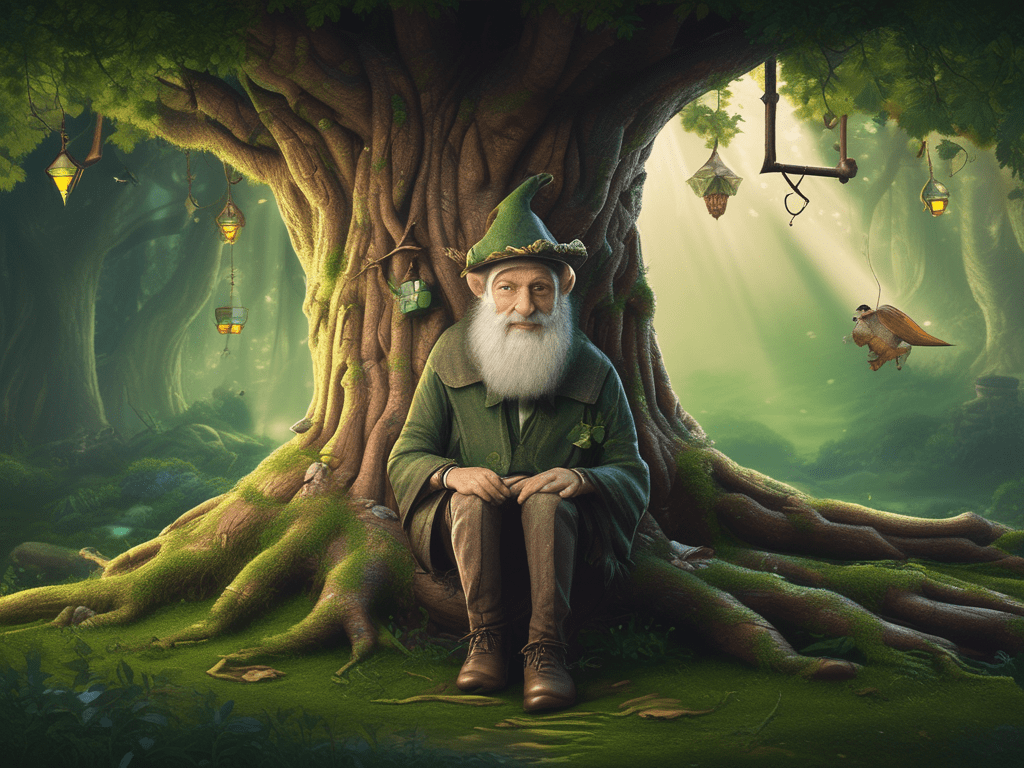
When the labours of a hard day are over, and the golden rays from the sun have settled beyond the reach of the bracken, oaks and heather, Dartmoor can become a foreboding, desolate and unsettling place. This was ever more-so, in the days before the advent of the telegraph and the railways, when the scarcity of news and infrequency of travellers led to an isolation which fostered a belief in witchcraft, ancient superstitions and fearsome, otherworldly creatures. It was no wonder therefore, that when the local moor-folk found company in each other, huddled around the smoky warmth of a peat fire, that conversation would turn not to the happenings of the time, but the stories and tales for which Dartmoor is so famous.
Amongst the tales of ghosts, witchcraft and strange happenings, stories of the piskies proliferated. Sometimes helpful, often times mischievous, but always entertaining, the stories of the Dartmoor Piskies, perhaps more than any other, seem to reflect the everyday of the folk that call Dartmoor home. I will endeavour to retell as many of the stories of Dartmoor Piskies as possible through this blog, but first, I thought it would be useful to set out what (/who) the Piskies are.
What Are Piskies?
A piskie (also known as a pixie, pisky or pigsie) are mythical creatures who appear to be predominant in the southwest, and in particular the moorland areas within Devon and Cornwall. Piskies are said to be a type of Fairy and in this sense, they can be said to be thought of as a non-human yet material being with magical powers.
The stories of the piskies, and therefore their actions, can be divided into two main groups. The first is the “social” piskies who live in communities of their own, occasionally being seen dancing, feasting and revelling, who encounter weary or troubled travellers. In this aspect, the piskies can be generous and kind, offering good fortune and riches to those who treat them well (see the story of Jeremiah Toope here). Reflecting their human counterparts, the kindly nature of a piskie does not always come true and a number of stories also tell how an encounter with a band of them can lead you to being “piskie led”, being cursed and even having your child stolen.
The second group is that of the “household” piskie, who is often a lonely figure who attaches itself to a farm or household, acting as a benevolent helper, protector or good luck charm. Under no circumstances however should a household piskie be spied on, cheated or laughed at, as if this happens, at best the piskie and their utility will disappear, at worst, they may become as noisy and disruptive as a poltergeist.
On the whole, the stories about piskies, particularly those on Dartmoor, do not show them as malevolent, but rather being amiable and helpful to the moor-folk. However, the stories also tell us not to take their generosity for granted and it is therefore wise to leave the piskie an offering of good will. They are not extravagant in their expectations so the offering does not need be grandiose. Crossing tells us that “a pin will suffice, or a piece of rag, provided it is sufficiently large to make a garment for one of these little folk”. Extending this offering from the realm of what could just be described as rubbish, it was not uncommon to leave out a dish of cream or small plate of food, as it was said “as long as one fed them they would view favourably upon the household and help when needed in times of trouble”.
What do Piskies look like?
The specific appearance of a piskie depends on who you speak with, however there are consistencies in their appearance which we can take forward. Firstly, they are small, being described as being no more than a couple of feet and more often than not, being only a few inches high and often, being so miniscule as to be nearly invisible.
Traditionally, piskies are described as wearing dirty, ragged clothes, which they may discard for gifts containing new clothes. On a few occasions, the ragged nature of their fashion sense is used to their advantage, where, disguised as a bundle of rags, they are able to lure their unsuspecting victims into a prank.
In the modern era, piskies are usually depicted with a mischievous grin, pointed ears and with large eyes that are pointed upwards at the outer ends. Traditional descriptions however have the piskies looking like humans, with long hair that hung over their shoulders, bushy eyebrows and the males (I don’t know how they determined the sex) having long, wispy beards.
Where do Piskies come from?
There are many theories as to where the belief in piskies came from. A predominant thought comes from Christianity, in that the piskies are the souls of children who had died unbaptised. Indeed, there are stories that take this belief further, when Eve, having been thrown out of the Garden of Eden, was to be visited by God. In preparation she bathed her children, but this task was not finished upon the arrival of the omnipotent, omniscient, omnipresent being. Those children who were not clean were not taken to meet the almighty. Once assembled, God asked Eve if this were all her brood to which she replied, “it surely is”. Is response to this lie, God declared “let those unseen remain unseen,” and from that time onwards all her children who had not been bathed became invisible to the human eye and banished to roam the earth for ever as Fairies who later became Piskies.
In a similar vein to unbaptized children, Evans-Wentz suggests that piskies are “the living souls and bodies of the old Pagans, who, refusing Christianity, are miraculously preserved alive, but are condemned to decrease in size until they vanish altogether.”
Leaving behind the theories that ultimately emanate from Christians dissuading their contemporaries from worshipping pagan gods and going unbaptised, the next theory I’m aware of stems from a belief that piskies are actually just small humans. This belief comes in two forms, the first that were pre-Celtic peoples, who lived in forest and farmed the lands for the taller, stronger Celtic people. Taking this on a bit, the second belief is that piskies are actually the Celts, who being smaller the various Roman and Saxon invaders who came to these lands, fled to the hills and lived in the woods and caves.
Finally, on a trip around the Southwest in the early twentieth century, the American anthropologist, Walter Evans-Wentz recorded the belief in Cornwall that piskies were the spirits of the recently departed, with the belief that “the piskies were apparitions of the dead come back in the form of little people”. Whatever the truth of their origins, the consistency of stories about piskies ranging from the Celts all the way up to the twentieth century gives an indication of the enduring belief in their existence.
Whether piskies are real or not, I’ll leave you to decide, but what I will say is that the numerous stories of the little folk help add to the mystical, magical sense of Dartmoor and the stories of the help they offer point towards the hardship that the moor folk went through and I look forward to sharing some of their stories with you.


 Moorland Ramblings
Leave a reply to John Bainbridge Cancel reply