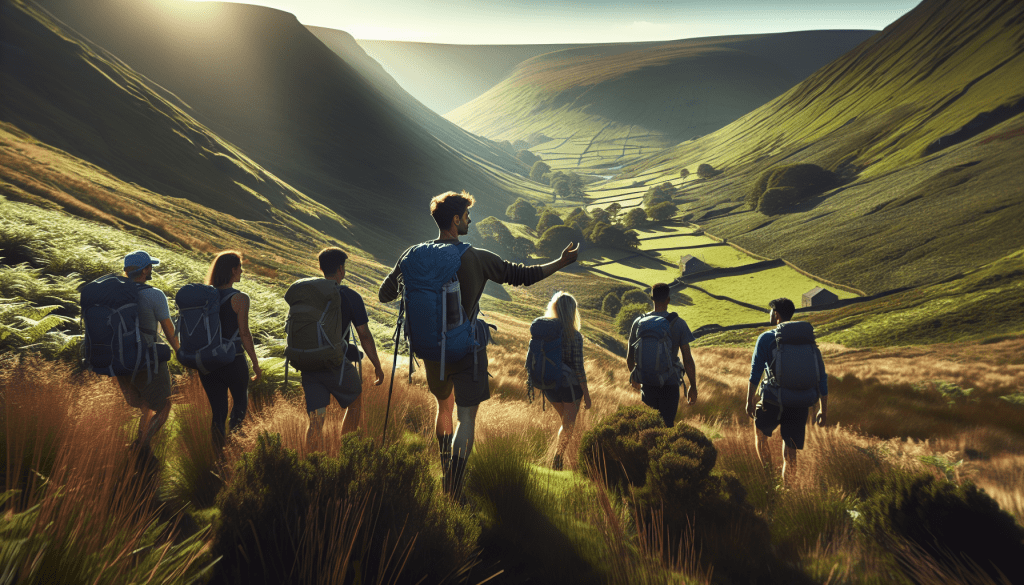
The wordpress software has an inbuilt AI which can be used to generate a cover image based upon the content of the post. I didn’t take any photos of my HML training or assessement and thought I’d give it a try. I think what it came up with is both hilarious and quite apt so I’ve used it here.
I passed my Hill and Moorland Leader Qualification (HML) in April 2024 (see my post about the assessment here). I just wanted to give a quick, overview of what the qualification is, why I did it and what the benefits are. I also include some top tips for anyone undergoing assessment.
What is the Hill & Moorland Leader Qualification?
The qualification encompasses x2 aspects, training and assessment. It is designed to support and enable keen hikers to lead hill walking groups in summer conditions during the day (additional qualification can be added to support overnight trips (e.g. the Camping Leader Qualification)). The qualification is only applicable for a Hill and Moorland environment and for an environment to be thought of as suitable, Mountain Training suggest the following four criteria are required:
- Open, uncultivated, non-mountainous high or remote country known variously as upland, moor, bog, fell, hill or down
- Areas enclosed by well-defined geographical or man-made boundaries such as classified roads (areas that merge with mountain regions and do not have well defined boundaries are excluded)
- Areas of remoteness that are easily exited in a few hours, returning to a refuge or an accessible road
- Areas where movement on steep or rocky terrain is not required (in either a planned or unplanned situation)
Why did I pick the HML?
I love hiking over Hills and live on Dartmoor (as the name suggests a big moorland area) so the HML qualification (as opposed to lowland or mountain leader) seemed a logical choice for me.
Why did I want a walking qualification?
I love hiking. I love the physical challenge. I love the mental challenge of navigation and I love the feeling of satisfaction when you’ve negotiated a long and tough walk. I love the physical and psychological benefits hiking provides and I love the space, solitude and opportunity for reflection the hills offer. I wanted to inspire this love in others and particularly in those who are less able to access the hills. To do this safely and competently, I felt I needed a walking qualification.
Since starting the qualification, I have been able to lead groups, teach navigation and apply my skills with the Army Cadet Force.
What are the Benefits of gaining the Qualification?
For me the big one is confidence. I know feel confident to lead and teach groups in the HML environment. I think this was especially important for me, as growing up in London I didn’t get the benefits of spending every weekend / evening in the hills (I spent months during the summer in the lakes which gave me the individual skills, but not being part of or leading a group). Therefore, for me the skills I learnt through the HML were less about the technical aspects of walking and navigation and more about the “soft” skills of teaching and leading groups.
In addition, the consolidation period (the period between training and assessment) really made me focus on my knowledge of the outdoors. My childhood meant I knew what a pigeon and a fox looked like, but not much else. Now I can identify different types of lichen and mosses, indicator species for temperate rainforests and all sorts of birds and animals… and I can even tell you about them!
What was the hardest thing about the HML journey?
The training and consolidation period were fun. Doing what I loved and feeling a sense of purpose for it. The hardest bit was therefore the assessment (see my separate post here).
Within the assessment process, the difficult bit was concentrating on my navigation when not leading – talking with the other candidates meant distraction from where you were, and knowing where you are at all times (including other legs) is key to the assessment.
I’ve heard other people say they forgoed speaking with their fellow candidates on their assessment, so they could focus on nav. I think this was a particular strength of our group. It showed that we can lead and know where we are despite distraction and was a clear technique from our assessor. If going for assessment, I would recommend getting used to this! On reflection, being tested like this has made me a better navigator (another benefit to the “joy” of HML assessment)!
Recommendations for HML Assessment
Enjoy quality days. This links with below but honestly… this is meant to be a passion, what you love and what you want to do! The quality days are just a self-assessment of that. Enjoy them. I felt pressure leading up to my fortieth – this was stupid, and actually one of the reasons I chilled out after I got it (I got all my QHLs and then did the assessment 8 months later)! The truth is, going and doing what you enjoy will lead to some quality days and some won’t. But enjoying all these will lead to your enjoyment and enthusiasm of the hills and you’ll pass that onto those you lead when the time comes… and I think that’s why we do this!!
Practice – the level of navigation required at assessment surprised me a bit. Get used to finding random features and quirky contours… this is what the assessor will use!
Recognise your weaknesses. Use your training days to learn where to strengthen. The truth is the assessment is hard but it’s hard because you question yourself… constantly! Tighten up on those areas of weakness and you’ll question yourself less (and let’s be honest… your first leg will test you on whatever you think your weakest at… it did for me!)
Enjoy it! This is a strange recommendation as I fully admit the assessment process is hard. But actually, in the buildup to my assessment I was excited to prove myself and having a few congratulatory beers post assessment was great! Honestly, you know the theory and you have the skills so chill out and enjoy a few days on the hills with likeminded people. And let’s be honest… you don’t nav under stress normally so doing it now won’t help!!


 Moorland Ramblings
Leave a reply to James Elkington Cancel reply