
Names
- Witches’ Butter
- Yellow Brain
- Tremella mesenterica
- Golden Jelly Fungus
Flowering Period
- Year Round
Identify
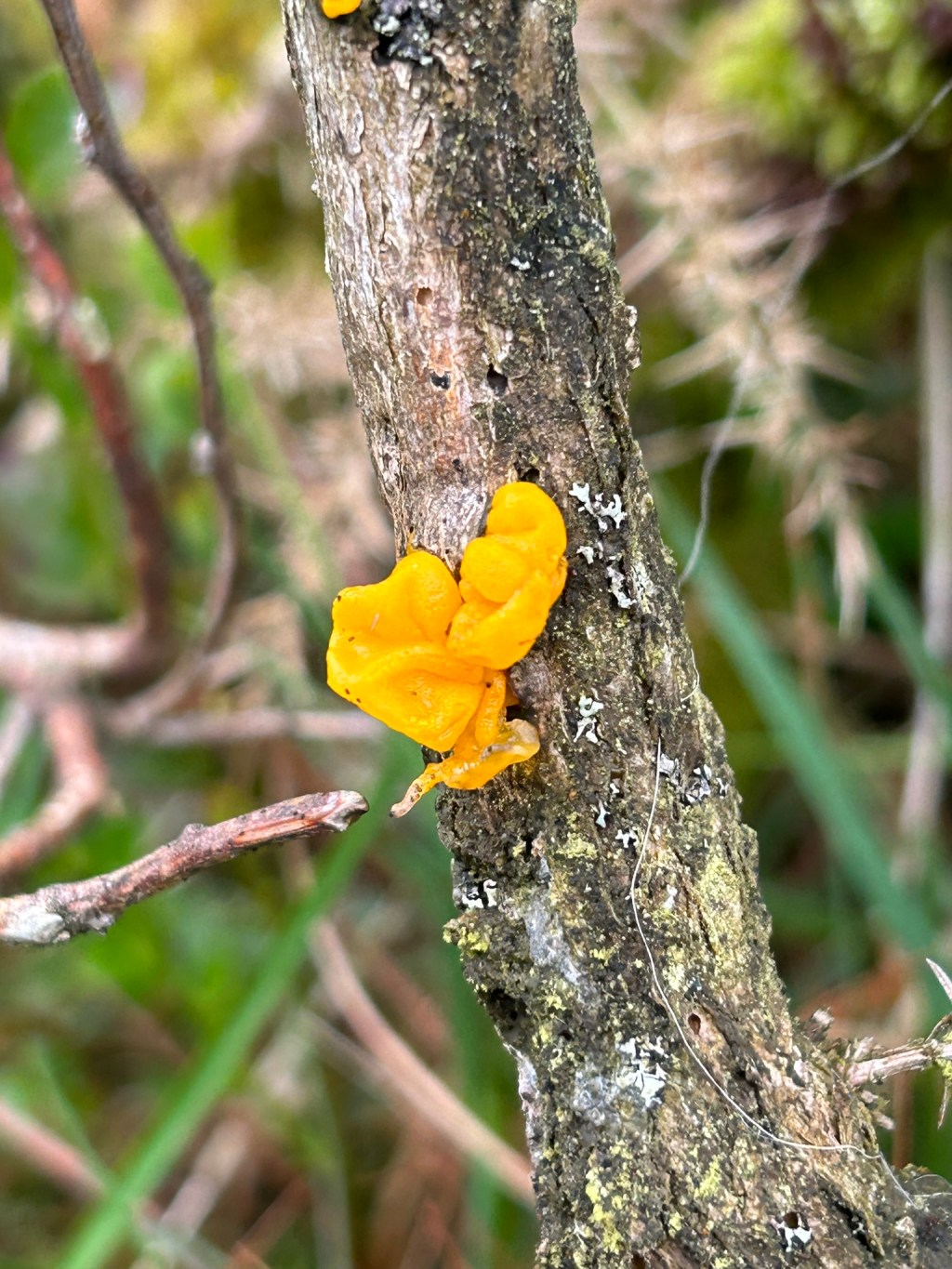
The fruiting body of Witches’ Butter is an irregular shape and smooth. Ranging from yellow to orange in colour, the lobes are tough and greasy or slimy when wet and harden as it dries out
About
Witches’ Butter is a fungus, which can be found throughout the UK and Ireland, is best seen on the fallen branches of deciduous trees, gorse and wood. A parasitic fungus, Witches’ butter feeds on wood-rotting fungi, which support the life cycle of our wooded areas and cycling of carbon.
As with most fungi, the visible yellow part of Witches’ Butter is just the fruiting body, as the main part of the fungus is an extensive network of thread-like mycelia living in the substrate of the wood.
Uses
- Compounds produced by the fungus have shown anti-inflammatory properties and as such, there is much research into potential medicinal uses
- In China, Witches’ Butter is used to add texture to certain soups.
Folklore & Mythology.
- Given the name, Witches’ Butter is heavily linked to witches in folklore. It is said that if it appears on the gate or door of a house it meant that a witch had cast a spell on the family living there and the only way to get rid of the spell was by piercing the fungus over and over with a pin, until it went away.
- In Sweden, Witches’ Butter was burnt to protect against evil spirits

 Moorland Ramblings
Leave a comment