
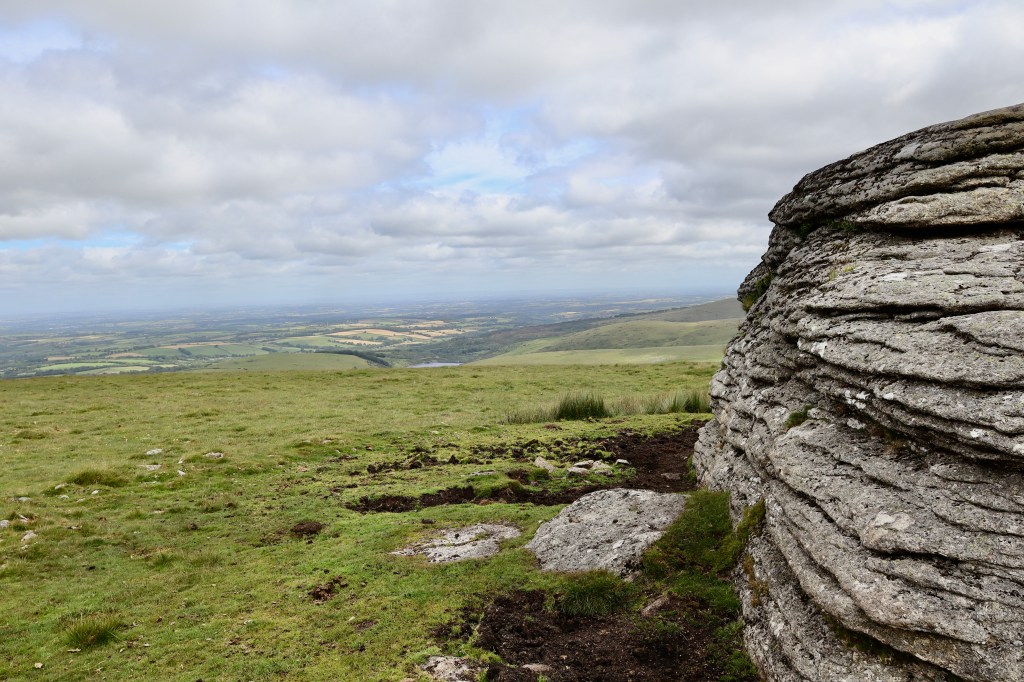
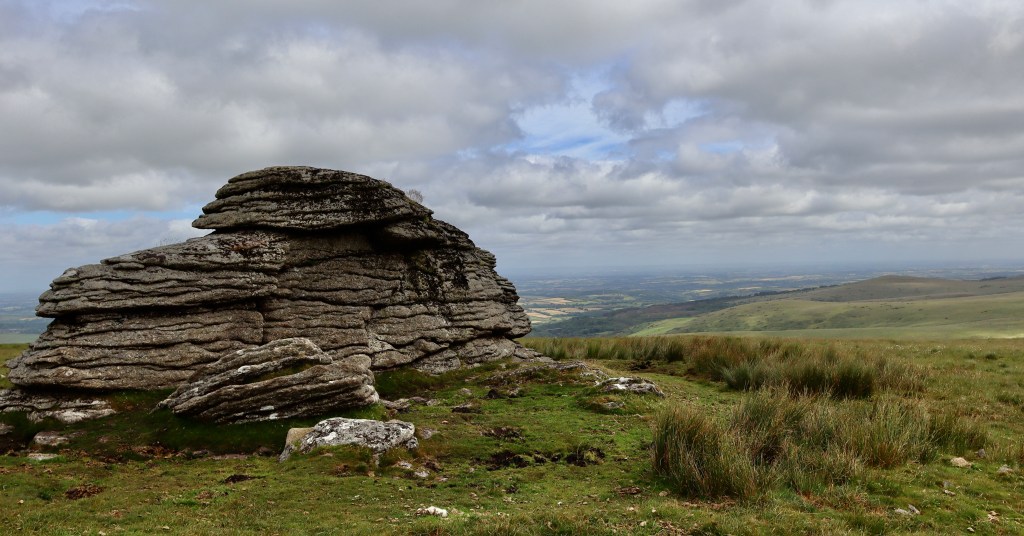
Branscombe’s Loaf is an isolated tor that sits atop Corn Ridge, in Prewley Moor near Sourton. Branscombe’s Loaf is a layered outcrop of granite, that sits contrastingly in the otherwise boggy moorland, surrounded by massive slabs, known as its cheese. Branscombe’s Loaf is small but offers up a good bouldering opportunity for anyone keen, and also allows for far reaching views across the Northern Moor and fields of North Devon. If the climbing, walking and views aren’t enough, Branscombe’s Loaf also has a great origin for its name and I’ve even found a song for it. If you want to visit Branscombe’s Loaf, see my route here.
Branscombe and the Devil
In 1900, famed Dartmoor folklorist Sabine Bearing-Gould gives us an explanation for the name of Branscombe’s Loaf, in an anecdote that acts as a parody to Satan tempting Jesus with food in the desert.
Between the years of 1258-1280, the Bishopric of Exeter was held by Walter Branscombe (often spelled Bronescombe). One evening, having visited a parishioner who lived on the Northeastern side of the moor, the bishop was travelling back home accompanied by an attendant. As they passed through Lydford and entered Prewley Moor, a deep, dark and swirling mist began to descend. In their panic, they hastened their horses and whilst doing this, the bishop lost his shoes and these now form the Slipper Stones.
Feeling unable to travel without his shoes, the bishop and his attendant began a search for them, mercifully as the mist was lifting. They searched all around, over Sourton Tors, around Shelstone Tor and across Lake Down and Prewley Moor without luck. Having searched for many hours, the bishop and his travelling companion, who were starving hungry and incredibly tired decide to head to the summit of Corn Ridge which the felt would provide a good vantage point to spot the mislaid shoes. As they ascended Corn Ridge, the bishop turned to his attendant and said:
“Our Master in the wilderness was offered by Satan bread made of stones. If he were now to make the offer to me, I doubt if I would have the Christian fortitude to refuse… Bread and Cheese I could not hold out against”
You can probably tell where this is going now, but no sooner had the bishop uttered these words then a lone moorman appeared over the brow of the hill. Remarking on the dishevelled nature of the two travelling men, the moorman removed a wallet he had strapped to his back and from it, pulled out a loaf of bread and some cheese which he offered to the pair, but on one condition. This condition was that the bishop got down form his horse, doff his cap and refer to the moorman as “Master”.
Reluctantly, but driven by his hunger and tiredness, the bishop got off his horse and received the bread and cheese from the stranger as he began reaching up to his hat. As this was going on, the attendant, concerned for the welfare of the bishop, was staring at the moorman. As he did, he noticed something disturbing. Underneath the long, dark travelling coat of the moorman was not feet, but cloven hooves. Recognising this as a sure sign that the helpful stranger was in fact the Devil himself, the attendant shouted a warning to Bishop Branscombe and knocked the bread and cheese from his hand.
As soon as the food landed on the ground, a smell of sulphur filled the air and the moorman disappeared. Once again, the mist was descending, but this mattered not to the bishop and his companion, as something more unsettling has occurred, the bread and cheese has turned to stone on the spot they had landed and remain there to this day.
The below song was found on page 45 of the brilliant Dartmoor 365 by John Hayward (Haywood J. (1991). Dartmoor 365 (3rd Ed). Curlew Publications. Pg45).
Bishop Branscombe once set out
From the town of Tavy,
Wined and dined on mead and stout,
Meat, two veg and gravy.
Reg his pageboy went with him,
Helped to keep him merry,
Fortified with Eau de Plym
And a cask of sherry.
Soon they climbed the western slope,
Toiling through the heather,
But they went on buoyed with hope,
Braving wind and weather.
Then their way grew steeper still:
Now they found if tiring:
Plodding on with steadfast will
They were both perspiring.
“Sir, I can’t last out the day
Now the wind blows stronger,
I am sure we’ve lost the way,
I can go no longer. “
“Cheer up Reggie”, said the Bish
“I espy a stranger,
Just the Person we would wish,
Tis a Dartmoor Ranger.”
On they hurried ‘cross the moor,
Stumbling through the clitter,
Oozing sweat from every pore,
Wishing they were fitter.
“Mornin’ all”, the ranger said,
“Where be you a-walkin’?”
But the Bish was puffed and red,
Hardly fit for talkin’.
“’Pon my word”, the Bishop said,
“Us be tired an’ weary,
Trudgin’, thirsty and nfed,
O’er this landscape dreary.”
“Take this loaf” the stranger cried,
“Put some food within you.
Once you’ve got it safe inside
You can then continue”.
Bish, he took the bread to eat,
Thanked the gen’rous stanger.
Just then Reggie saw the feet
Of the so-called ranger:
Poking out from ‘neath the coat
Twas not shoes he wore there:
Two feet cloven like a goat
Worthy Reggie saw there.
Sprang he into action quick,
Smashed the loaf asunder,
Hurled invective and Old Nick
In a voice of thunder.
“Well done, Reg” the Bishop cried,
“Thanks for your devotion.
When we reach the other side
You will get promotion.”
Satan fled with muttered curse,
“Bother and damnation.”
On they plodded, none the worse,
To their destitation.
Page and Bishop on they went
Through the dreary weather,
Left the loaf without lament
In the purple heather.
Still it lies on Goodbridge brow,
Gives this story credit,
‘Branscombe’s Loaf’ they call it now
Though ‘tis made of granite.
Page and Bishop, they’re not here,
They have gone to heaven,
But Old Nick is much more near,
He still lives in Devon.


 Moorland Ramblings
Leave a comment