
Urban Hiking
Urban Hiking or hiking through a city can be just as rewarding and challenging as hiking through the countryside. Urban hiking often offers up varying terrain, inclines and natural wonders just as a hike through the countryside can, but it can also offer up cultural landmarks and easy access to fancy cafes and trendy pubs. Often, those of us who spend our weekends scrambling over mountain ridges and knee deep in blanket bog don’t often think about urban hiking as an option and as such, our cities often aren’t given the credit they deserve for the natural landscapes they can offer. Take my home city of London as an example. Yes, there are plenty of dual carriageways, smoggy ring roads and decrepit, litter strewn streets, but there are also wetlands, ancient woodlands, nature reserves, marshes and scenic river and canal walks. In fact, in 2019, the nation’s capital, in an attempt to better connect the residents with nature, became the world’s first Natural Park City.
I’ve mentioned on a few occasions that I am Londoner, born and bred and so regularly visit the city and as such, I will include a number of walks from the city in the blog, and in the repertoire of guided walks I offer out. The Parkland walk, a linear nature reserve that follows the route of a former railway line connecting Finsbury Park to Alexandra Palace is the first of these.
Alexandra Palace
The route I pick links two places well known to me, Alexandra Palace, near where my mum lives, and Holloway, where I lived prior to my move to Devon. The weather is perfect, with a gentle breeze providing merciful relief from the beating sun, set in a clear blue sky. My route starts at Alexandra Palace, and more specifically, at the entrance to Alexandra Palace on Alexandra Park Road. The route starts with an incline, which takes you between the fences of the long-abandoned deer park (in fact, the deer acted as the trailblazers for me as the herd of fallow deer were moved from the Park to Devon). As I walk on, I am greeted by the slightly odd site of children’s faces popping up and over the trees, as they enjoy the thrills that “Go Ape” offers.
It is here, that the first hazard of walking in London emerges, as my intended route to the front of Alexandra Palace is blocked by heavy duty metal fences and heavy-duty looking security guards. A bit of curiosity and googling shows that the Red Bull Soap Box Race is on in a couple of days, and my intended path (for anyone that knows Alexandra Palace it is the one that runs alongside the old dry ski slope) is bang in the middle of their staging area. Taking the opportunity to divert around the Alexandra Palace boating lake, I eventually bring myself to the front of the palace and one of the best views London has to offer.
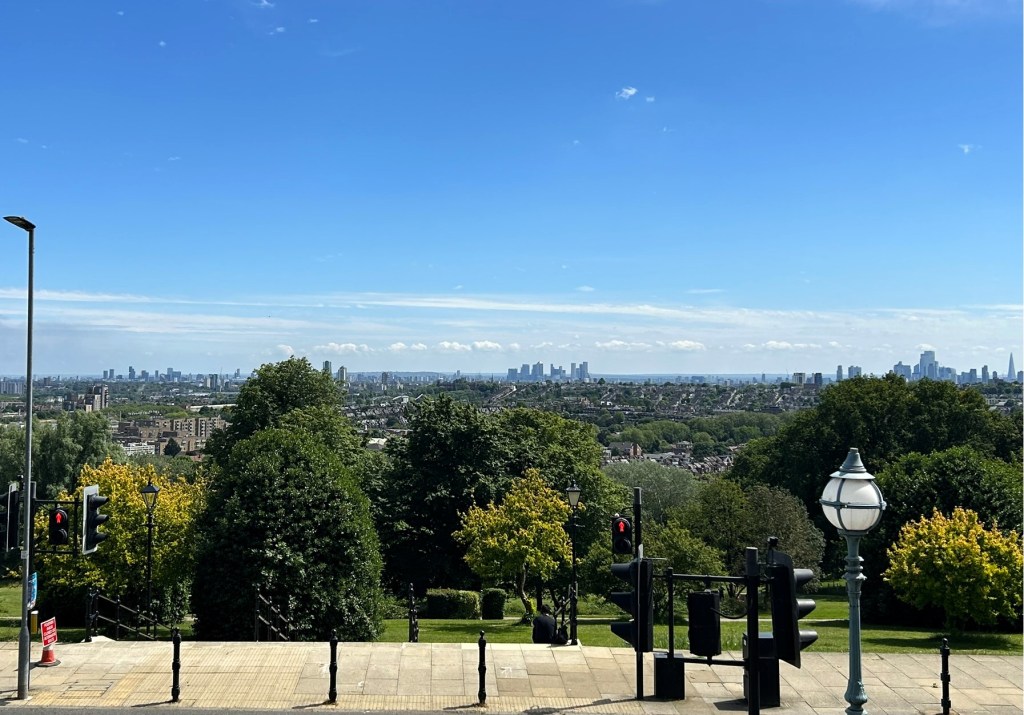

Alexandra Palace, often referred to as “Ally Pally”, is located on a ridge and offers panoramic views to the South, over the City of London. The palace has a long and varied history and is probably best known as the birthplace of television, as the BBC leased the eastern side of the building to make the first public broadcast television programmes. More recently, Alexandra Palace has been rebranded as a world class entertainment venue, hosting multiple sporting events, festivals and concerts.
Marvelling at the regeneration of not just Alexandra Palace, but the surrounding area since my childhood, I continue along the palace path, through the large beer garden. As I do, I’m greeted by a sight that shows that whilst I may be in London, the trappings of the countryside are never far away, as a tractor trailing a load of hay bales with frustrated drivers stuck behind, trundles along the road.
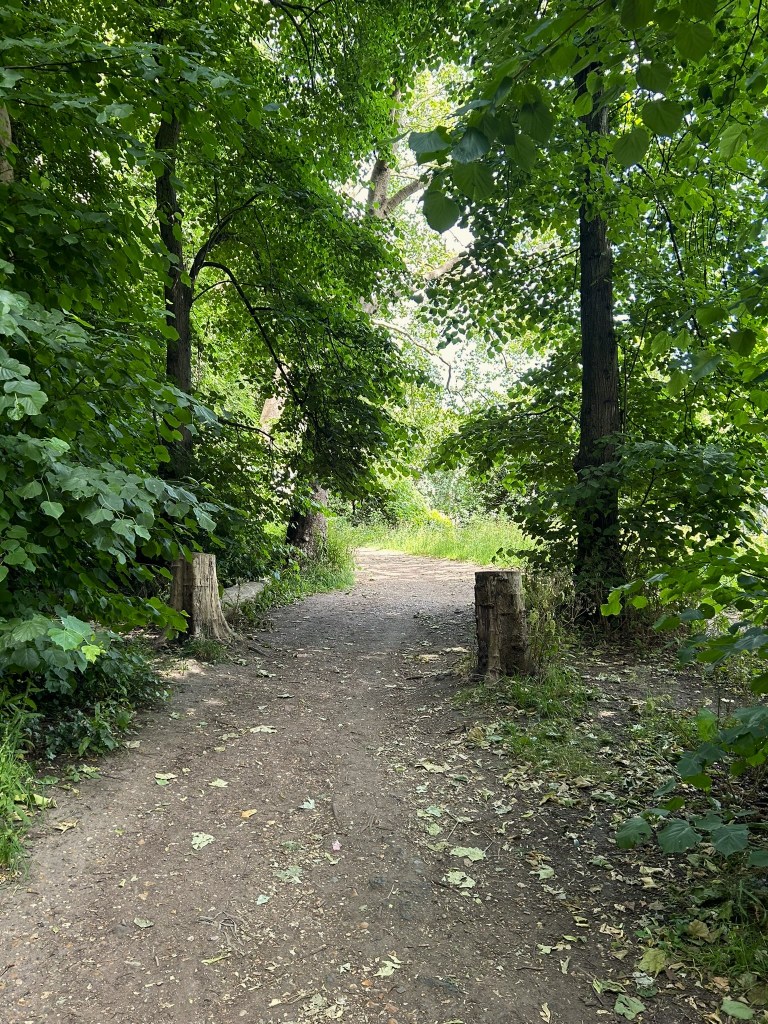
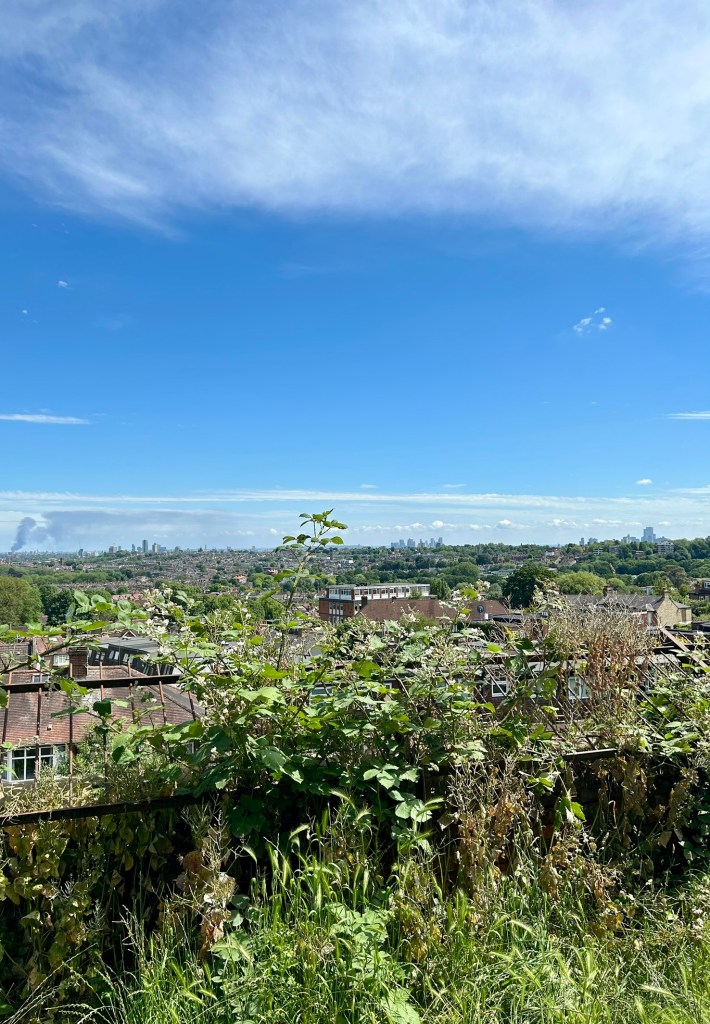
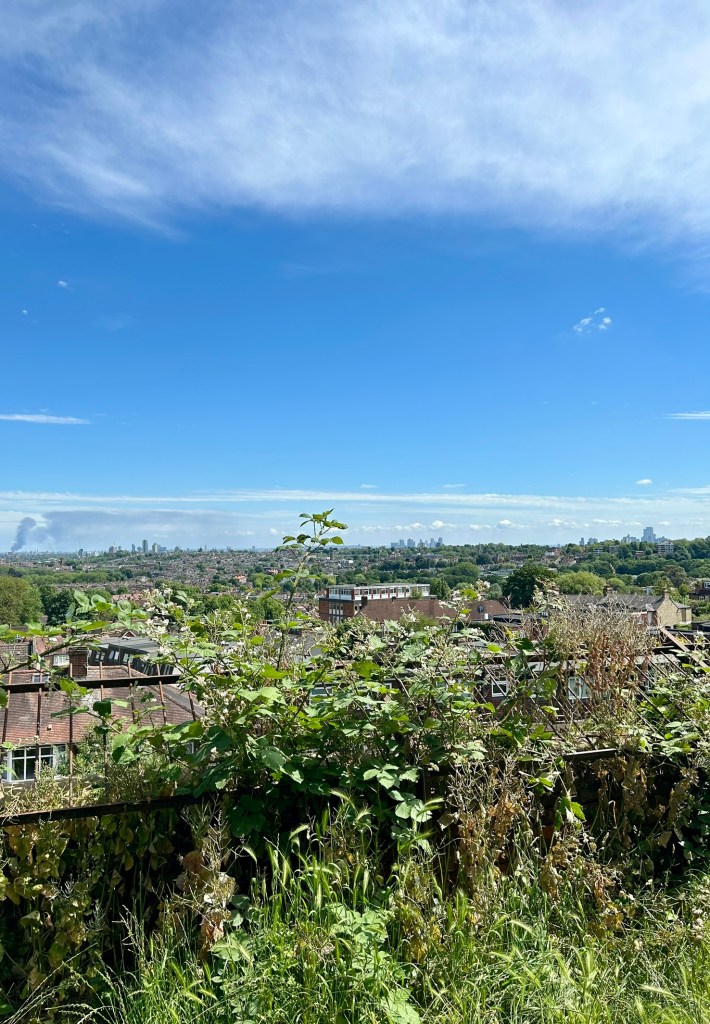
From here, continue along the path with the park edge to your left which will eventually bring you out of the back of the park, and into Muswell Hill. Ignoring the opportunity to grab a coffee from Muswell Hill, the path continues beneath a bridge under the A504 road and to me, this feels like the true start of the trail. The path is well maintained and takes you through a young, deciduous open woodland, which has been left for nettles, grasses and natural flowers to grow. As you continue, to the left another view of the city opens up, which on this occasion, was dominated by a plume of black smoke. Not long after the view, a flood of childhood memories come to me, as I pass by a tyre swing being used by a group of kids. I used to play on this tyre swing when I was a kid and had completely forgotten where it was and so this was a welcome and unexpected moment of reminiscing. The simple rope and tyre (which let’s be honest won’t be the exact same as it was near enough 30 years ago) serves as a reminder of my youth and stands as a monument to the adventures and activities that got me so in love with the outdoors and walking.
Highgate Wood
Exiting the Alexandra Palace part of the route, the path brings you to a pavement in Highgate. Following this for about 10 meters you enter Highgate Woods through a narrow (like seriously narrow – there was a lot of sucking in my gut to get through) gate.
Highgate Wood is an ancient woodland made up of Oaks, Beech and Common Hornbeam, the latter of which offers merciful shade from the beating sun, desperately needed as I have not dressed appropriately for this walk, as I’m wearing jeans and heavy timberland boots when shorts and flip flops would be much more appropriate.
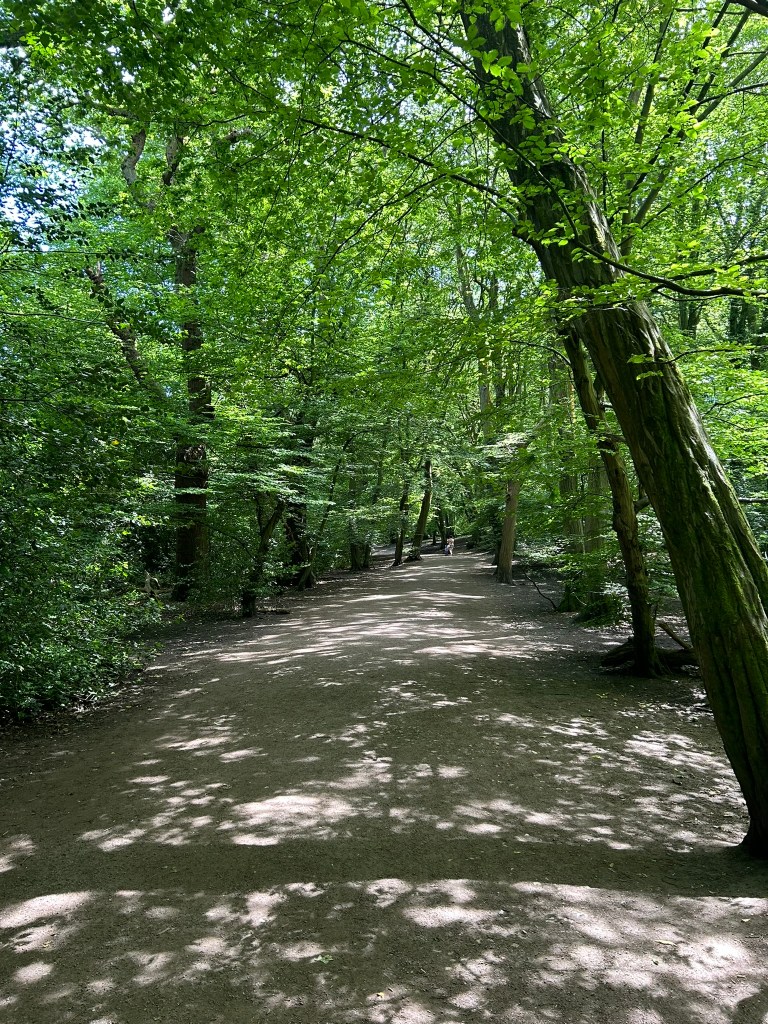
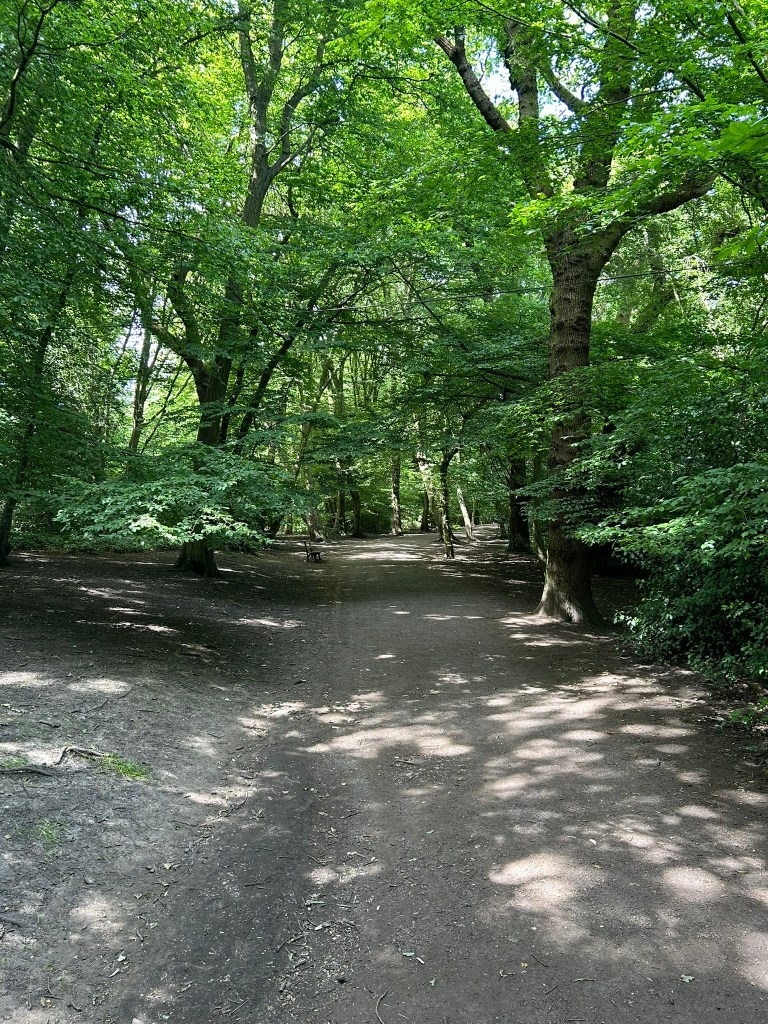
Highgate Wood was originally part of the ancient forest of Middlesex, which covered the majority of London, and the surrounding counties, and has been a site of human activity for thousands of years with evidence of prehistoric flints being found in the woods. Maintenance of the wood has not always been sympathetic to its historical and ecological past however as asphalt paths were laid, dead wood removed and ornamental trees planted. Thankfully, more recent conservation efforts have bene much more in line with the sensitivities of the ancient past and as such, areas of Highgate Wood have now been closed off to the public, allowing the regeneration of the vegetation and fallen and dead trees are allowed to decay ‘’in situ’’
Now, I have done this route a couple of times, but coming from the other direction, and the part through Highgate Wood has always confused me, to the point I’m not sure I’ve ever gone the same route twice. In any case, the ultimate aim of this stretch is to head towards the southern end of the wood until you find the gate that takes you out of Highgate Wood, across Muswell Hill road, and into Queen’s Wood. If it takes you a couple of loops of the wood to get to this point, well you don’t really lose anything as it is a beautiful place.
Queen’s Wood
When in Queen’s Wood, follow the green capital ring signs. The path takes you past a long dried up pond and a sign highlighting the centuries old bank and the soil restoration work. The ancient boundary bank is more interesting than you’d first think, having been built at some point in the 16th century, to protect the coppiced woodland from grazing deer, sheep and cattle (that sounds a familiar problem for our ancient woodlands) and unruly trespassers and poachers.
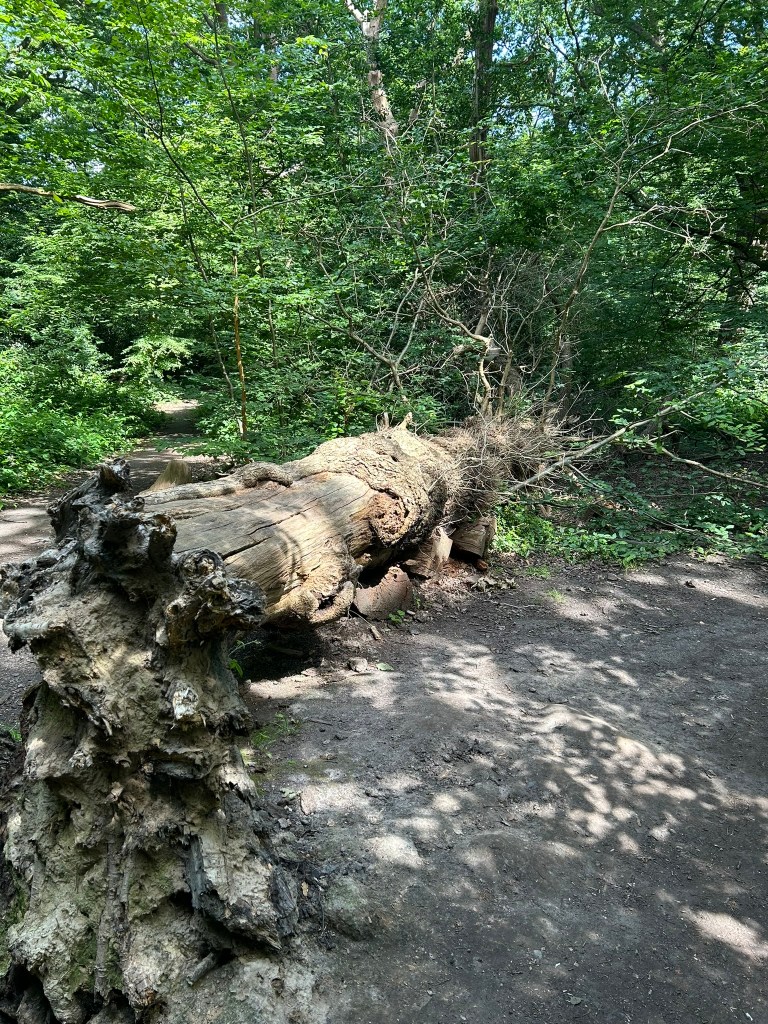
Taking the path that is signposted to Priory Gardens I once again cross over a road. Re-entering the wood on the other side, the path brings you to an exit onto the residential street. As you continue along this path, you will pass a fallen tree that has been left to provide a natural habitat for insects, bugs and birds, proving the renewed efforts of conservation referenced in the Highgate Wood section above. The tranquillity and gentle splendour of this woods is only slightly ruined by the overwhelming smell of weed that seems to permeate the whole place.
Entering onto Priory Gardens, turn left and then right at Shepherd’s Hill, past the well-maintained allotments and eventually left onto Archway Road. At The Boogaloo Pub on Archway Road turn onto Holmesdale Road and after about 100m join the Parkland Walk via the gate. As an aside, the queue of traffic along archway road that I so regularly used to sit in does serve as a reminder to me to be grateful for the peacefulness of my new life in Devon.
Parkland Walk
The Parkland Walk is 4km of linear nature reserve, the longest in London, and follows the former railway line connecting Finsbury Park to Alexandra Palace that opened in 1873. The popularity of the route has grown exponentially over the years and is now a popular escape from the mania of the City for Londoners and tourists alike. As such, when the sun is shining, the route often gets busy with dog walkers, cyclists, runners and urban hikers. It is easy therefore to get caught up in the flow of the crowd (it isn’t that busy but the metaphor remains), get your head down and plod along. This would be a waste however, and time should be taken on this route to take in the ambience and moment for quiet reflection that the Parkland Walk can provide.
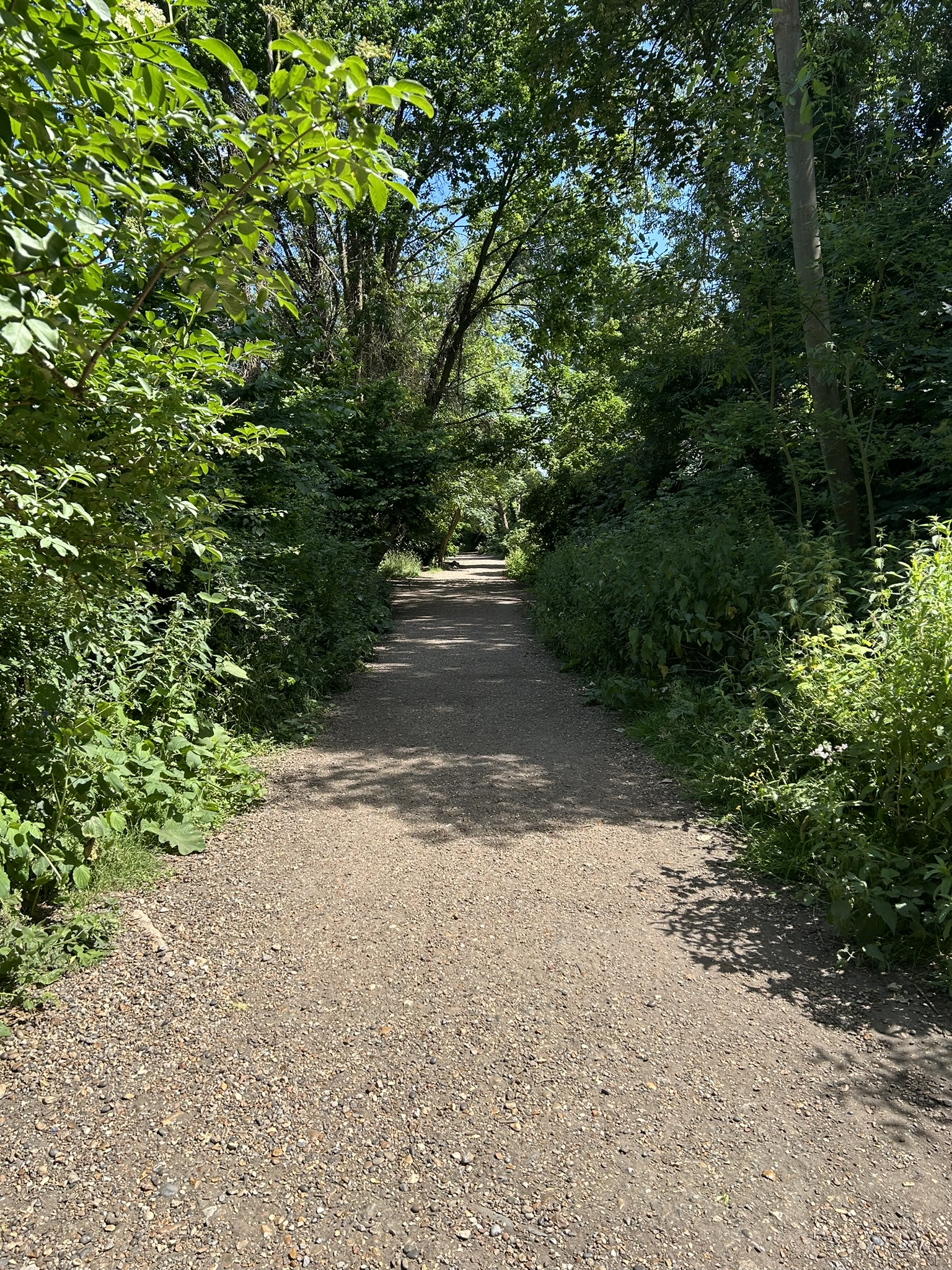
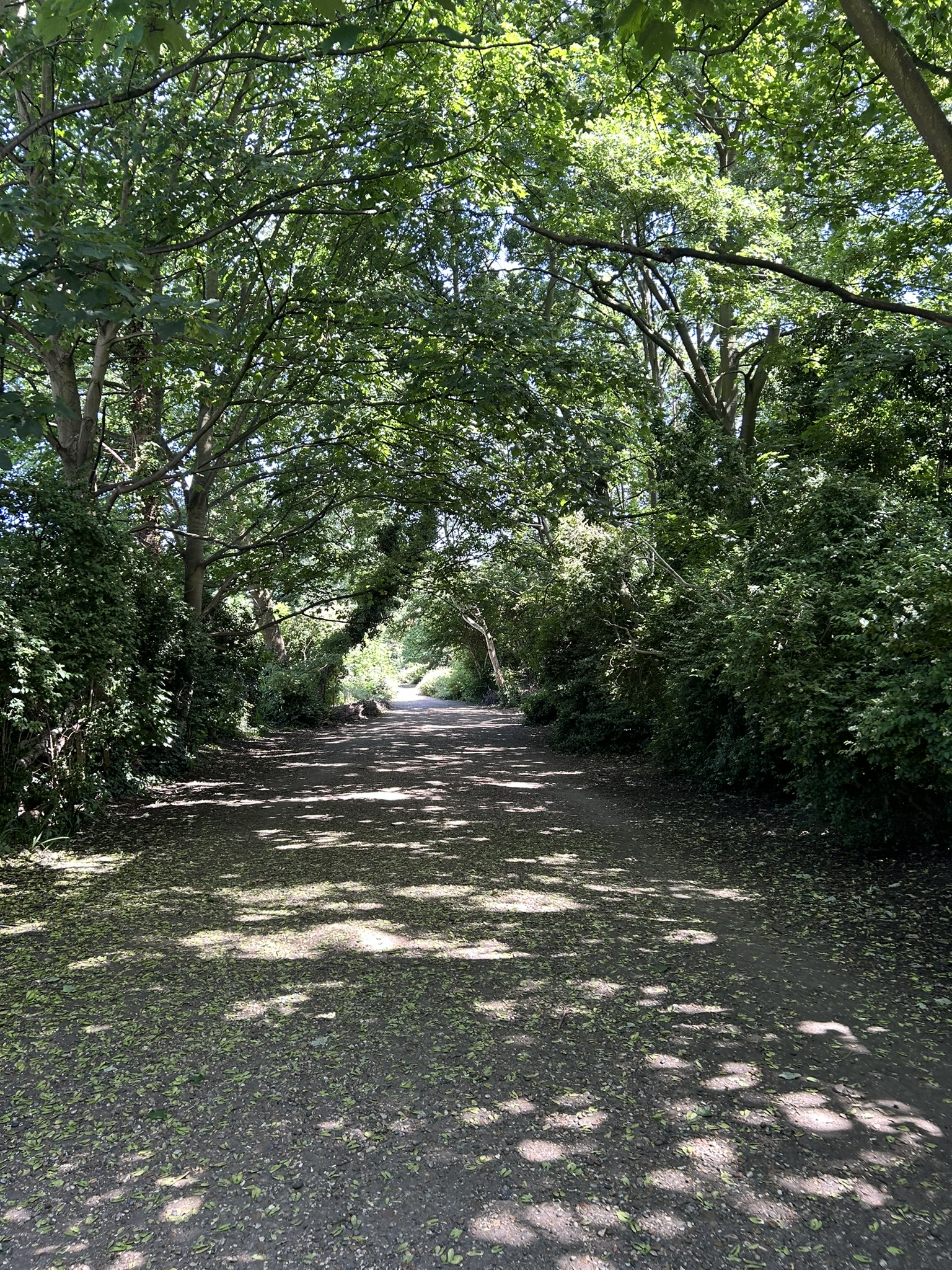
When entering onto the Parkland Walk, I just follow the path through all the way to Finsbury Park. Or at least that’s the plan. Once again, my path is blocked by some works going on to restore and resurface the Parkland Walk route (and will continue until December 2024 if you’re planning to experience the Parkland Walk before that). I therefore crack out google malls and take myself on a diversion down Avenue Road (which to be fair is a nice residential street) before entering back onto the Parkland Walk path at Crouch End Hill.
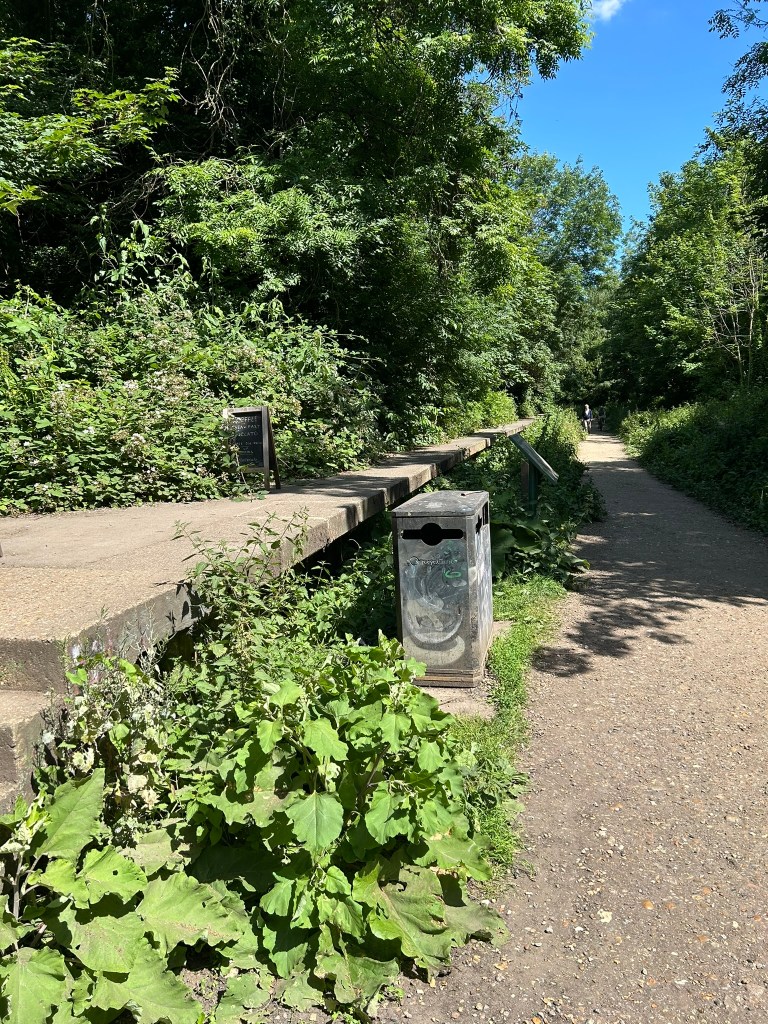
Anyway, back on track (or rather path) it is this point where the first real evidence of the Trainline comes in, as the route takes you through what was clearly and old station, with platforms raised up either side. The Parkland Walk route is a section of the old Edgware, Highgate & London Railway Line which opened in 1867, before being absorbed into Great Northern Railway. The railway transported passenger between Finsbury Park and Alexandra Palace up until July the 3rd 1954. Freight services continued for a further 15 years but were on a continuous decline and the last train ran on 29th September 1970 with the tracks finally lifted in 1971. Work to repurpose the old railway into the Parkland Walk we know today began with the Muswell Hill section (I’ve called the Alexandra Palace section). In 1990, the Parkland Walk was declared as a local nature reserve which continues to this day.
As you pass out of the old station section, look to the arches on the left. Up high and inside one is a Spriggen sculpture, a legendary creature found in the folklore of Southwest England. Spriggens are often described as grotesquely ugly, withered old men with large childlike heads and this sculpture certainly delivers on that. Spriggens are notorious for their angry presence and mischievous disposition, who delight in causing mayhem for any who offend them. This sculpture was added to the Parkland Walk in 1993, it was made by Marilyn Collins and was commissioned in reference to the local legend that a spectral ‘goat-man’ haunted the walk in the 1970s & 1980s.

Finsbury Park
I’m listening to music as I do this walk (it may be a nice walk but the car sounds and sirens are unavoidable at times). As I walk along the song “Strange Days” by The Struts and Robbie Williams comes on. This song is about the pandemic and it was here in London, not far from this route that I spent those strange days, using this path and Finsbury Park for my daily allowance of exercise. It sounds stupid but it brings back happy memories.
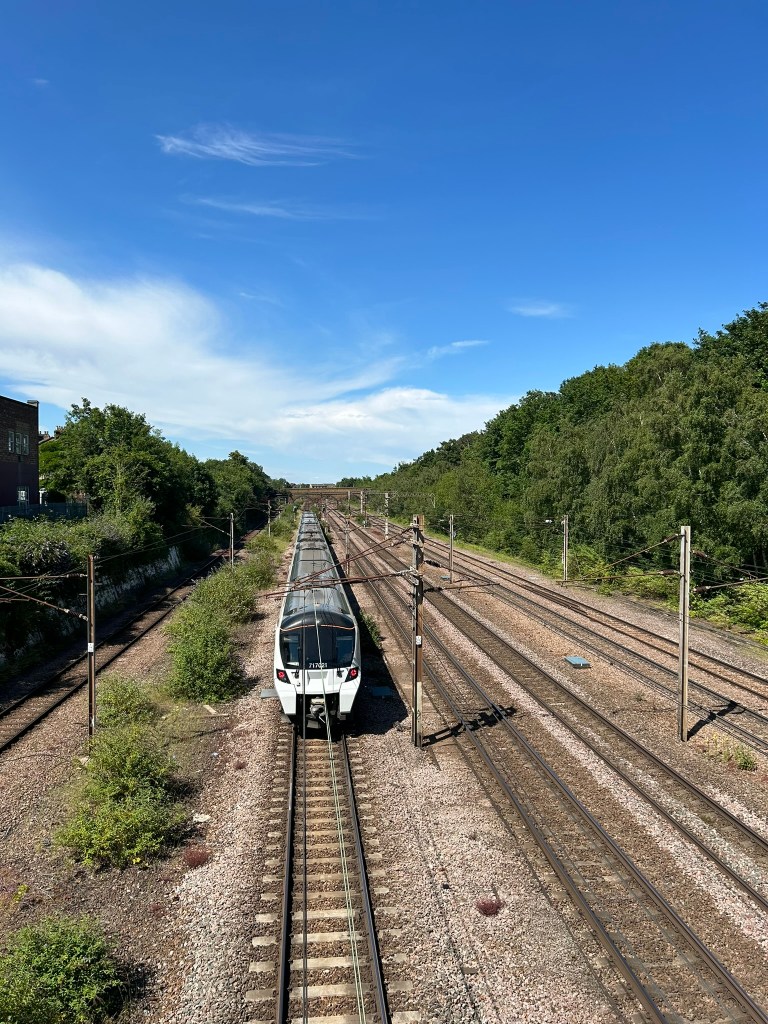
At the same time, the path nears Finsbury Park, and with it, the number of runners and dog walkers increases, as does the number of underpasses and so too the signs and sounds of urban life. This however doesn’t detract from the walk but rather adds to it. Providing a reminder of the urban environment in which this stretch of maintained and protected nature sits. The walk provides a very real escape from the stresses and strains of city like and is a glimpse that no matters where we live, we are never too far from our natural roots.
Gillespie Nature Reserve
Exiting the path into Finsbury Park I turn right, to carry on my route towards the pub (is a walk a walk without the pub?). Crossing in front of the busy Finsbury Park station as I move towards Holloway, the nature continues as I enter into the Gillespie Nature Reserve.
Gillespie Nature Reserve is home to a wealth of wildlife, including 244 species of plants, 94 species of birds and 24 types of butterflies. The beauty of Gillespie Nature Reserve was recognised in 2019, as it won Green Flag Award, adding to the London Conservation Area of the Year award from 2015. The area has separate habitats – grassland meadows, wetlands, woodland, hedgerows – each catering for different wildlife. Gillespie Nature Reserve also brings me to the best sight of the whole walk, the glorious Emirates Stadium showing off all her (as yet but hopefully not for much longer unfulfilled) beautiful promise (I had to include this and get a photo of the ground into the blog… I just had to). Exiting Gillespie Nature Reserve, I turn right onto Drayton Park Road which takes me to my end destination, my old local.

This route, shared by hikers, dog walkers, runners and cyclists alike shows us what Urban Hiking can bring. From it, we have history, architectural intrigue, conservationism and beautiful nature and I would highly recommend it as a peaceful escape from days spent in the city.
| Difficulty | Distance | Navigation Required? |
| Easy | 8km to Finsbury Park 9.5km to Emirates Stadium | No |
| Grid Reference | Safety | Footwear |
| N22 7AY to N5 1BU (emirates) | Road crossings | Anything |

 Moorland Ramblings
Leave a comment