I’m writing this route up a few weeks after walking it. As I write I’m looking out a window, over a field of sheep and horses munching on the grass and buttercups, whose bright yellow is being accentuated by a glowing, warming sun. The weather could not have been more different when I was on this walk.
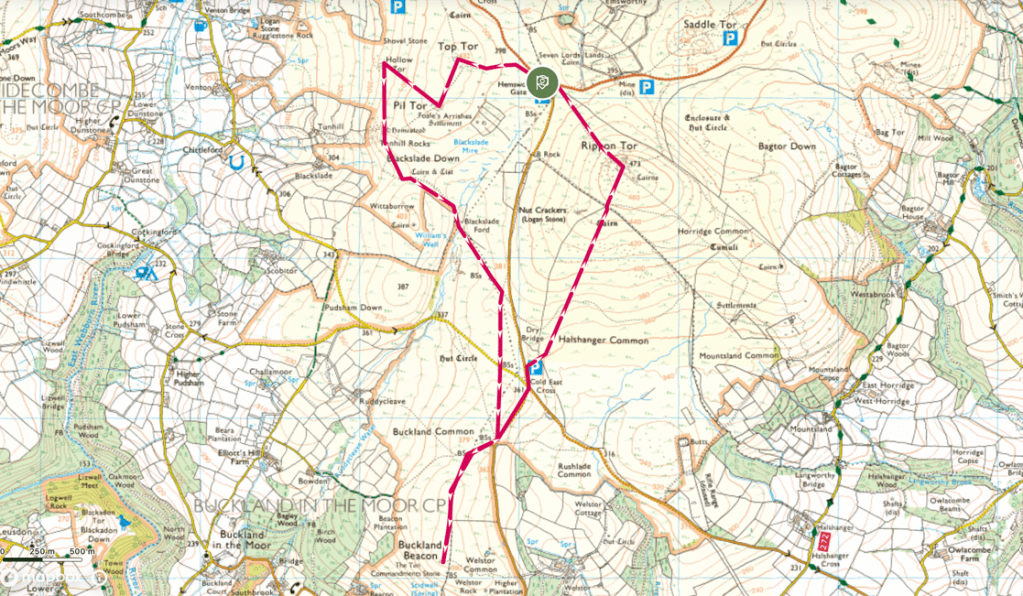
The route started, as so often, with a drive across the moors. Setting off early on a Tuesday morning, the weather was clear as the sun was rising and I was full of hope that this would remain through the walk. However, as I got ever closer to my destination, the clouds began to descend. By the time I parked up at Hemsworthy Gate, a small car park that sits at the base of both Rippon and Pil Tors, that offers a great starting point from which to discover some of Dartmoor’s best landscape, history and stories, the mist had arrived and visibility had left.
Taking a bearing, to counteract the poor visibility, I head off in a north-westerly direction, trudging through the gorse, and walk myself straight into a bog. Ruing the fact that my newly cleaned and waxed boot lasted all of 5 minutes on the moor before getting absolutely covered in the best the peat had to offer, I keep walking, accompanied by the whistling, rhythmical song of the skylark I disturbed. I continue on my bearing until thankfully, a path becomes apparent. Taking this, I keep walking until the prominent outcrops of Top Tor begin to emerge from the mist, silhouetted at first but then offering up the texture of the irregular, scruffy, fractured layers of granite that make the Tor recognisable. Being shrouded in mist, I don’t hang around at Top Tor for long and instead head to my next destination.
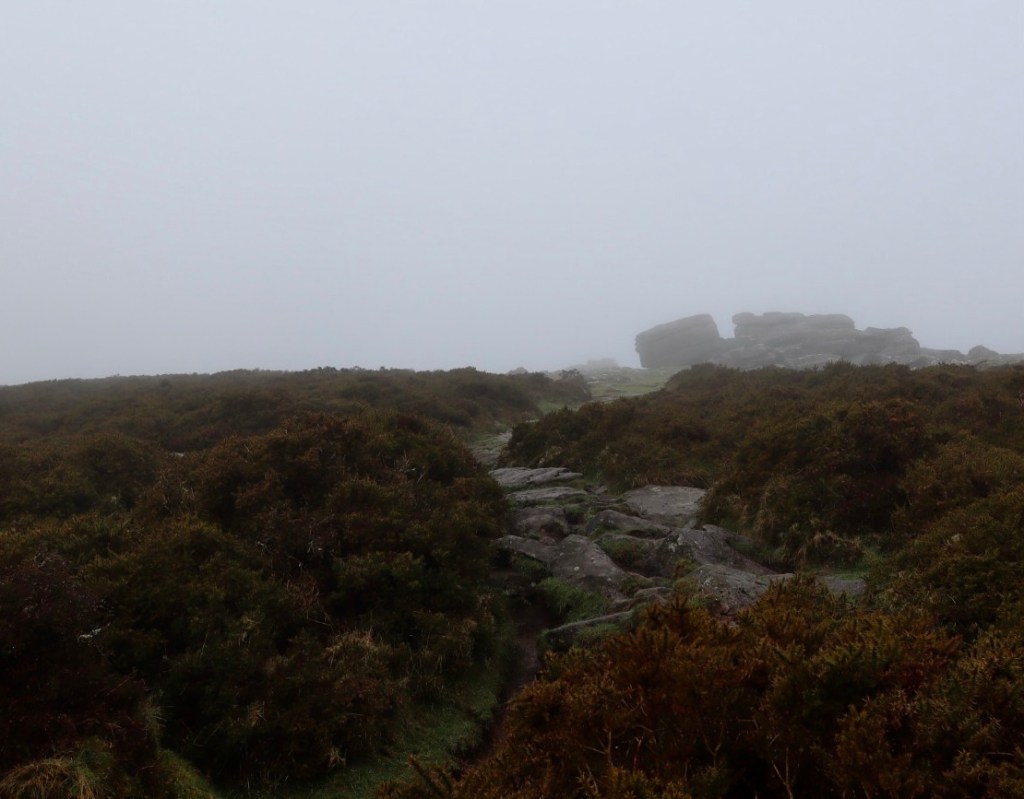
After about 300m heading south-westerly, I end up at Pil Tor. This tor is one of the many that can be found on Blackslade Down but is perhaps the most impressive. When viewed from a distance, there is nothing that sets Pil Tor apart, but when you get closer, it offers up a fantastic example of an avenue tor, with two prominent ridges of rock flanking a corridor that runs straight through the middle. As I pass through Pil Tor, the mist begins to lift and as I emerge on the other side of the corridor, the visibility is once again good. This is great news, as it not only means I can put away the compass and stop focussing on contours, but I can now also take in the wide-ranging view that is so loved from the top of Blackslade Down.

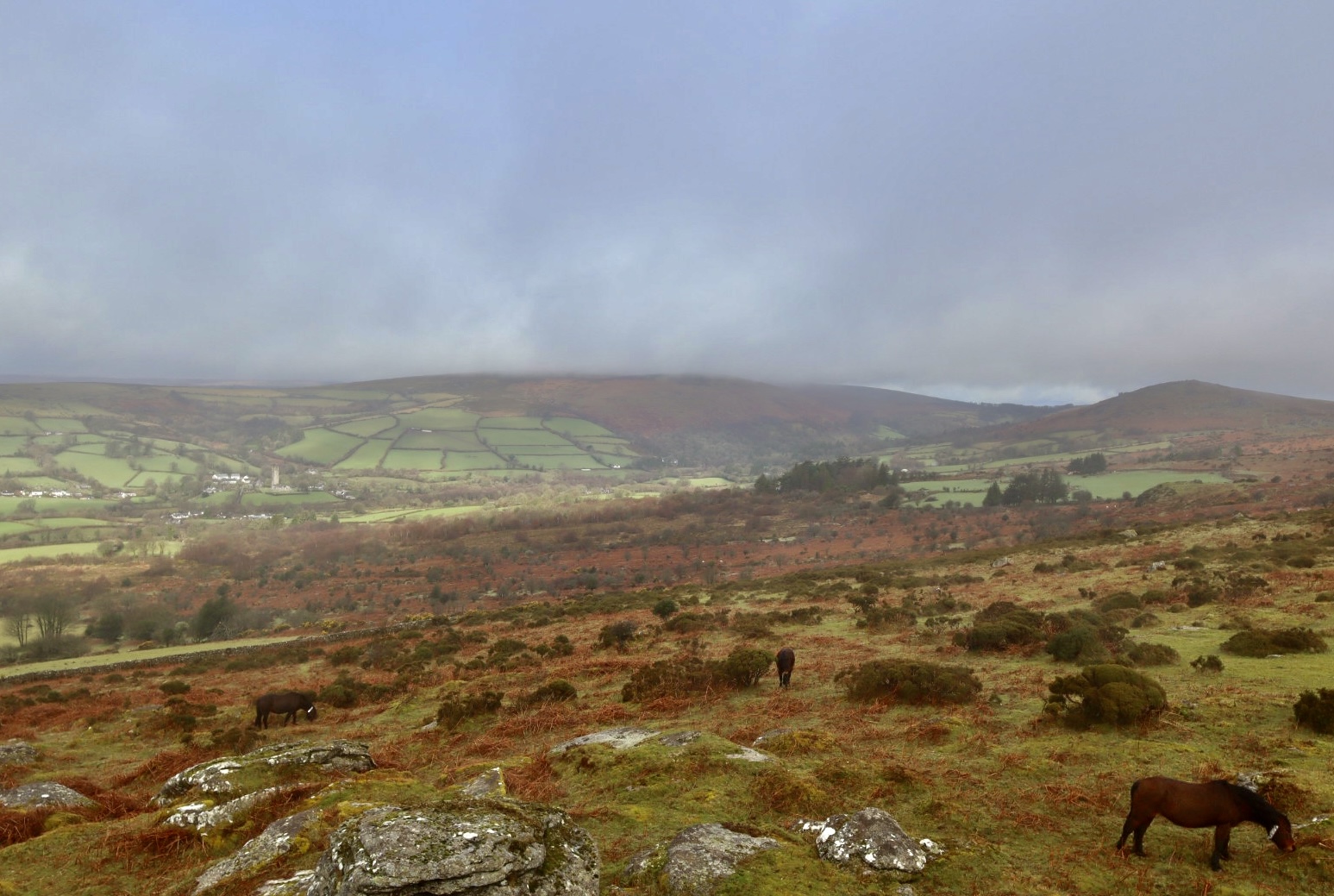
Walking down the hill, I head to hollow tor, which is about 500m away in a north-westerly direction. Offering up views over Widecombe-in-the-Moor (see the tales of this location in my post The Storm and the Fair) and over to Hameldown beacon. The Tor itself is nothing exciting as you arrive, as it is covered in grass, heather and gorse. A quick jaunt around the side showsthe deception of the tor. When approached from the North, East or South, it really offers nothing, but when viewed from the West, the stack of stone is noticeably 5 plus meters high and is much more impressive. All that being said, the most impressive thing remains the views.
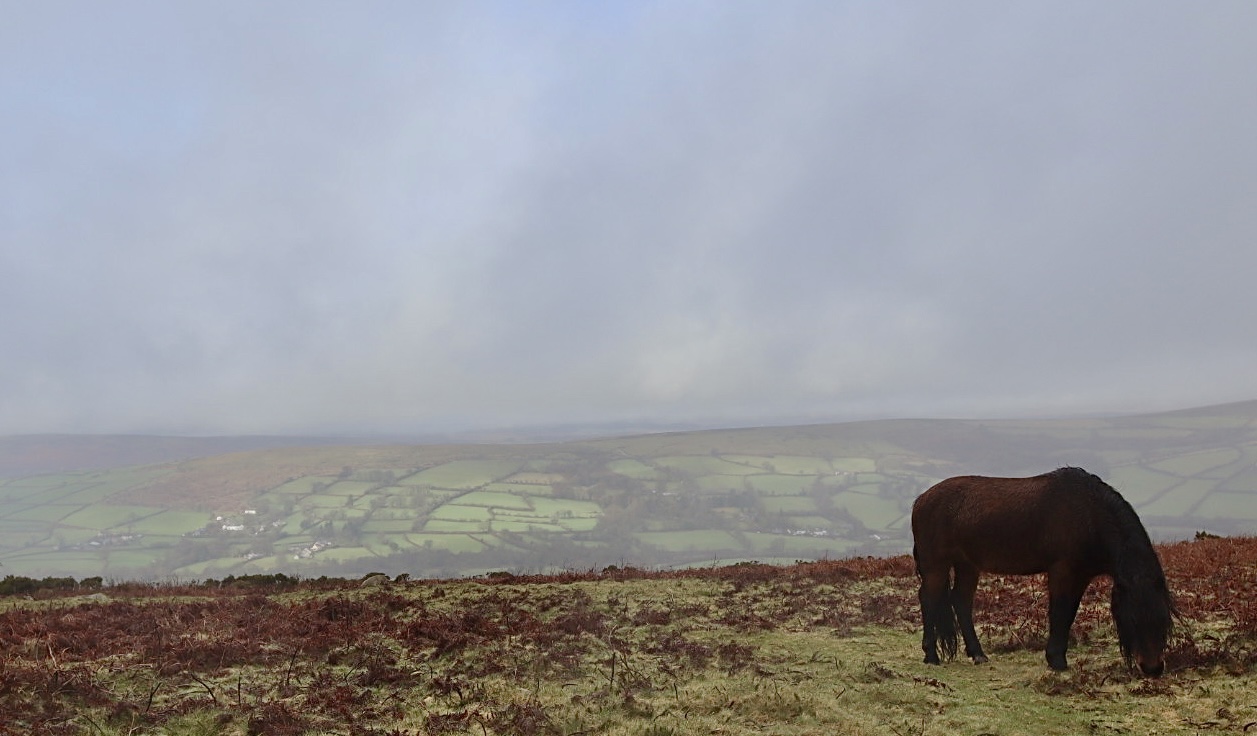
From Hollow Tor, heading south, I come to Tunhill Rocks. Despite the name, I think it is safe to call this a tor. This jumble of rocks, which spralls along the edge of the hill that drops steeply down towards Tunhill Farm, offers views in line with those of Hollow Tor, over Widecombe-in-the-Moor and the surrounding moorland. What this Tor also offers however, is a herd of Dartmoor Ponies, calming grazing the moorland scrub as I scramble around on the rocks above them, trying to get a good photo. Looking on OS maps, marked close to the tor is a “homestead”. This home has been reclaimed by nature, with only a few weather beaten, eroded rocks arranged in a circular pattern giving a clue to the distant past and history of this area.
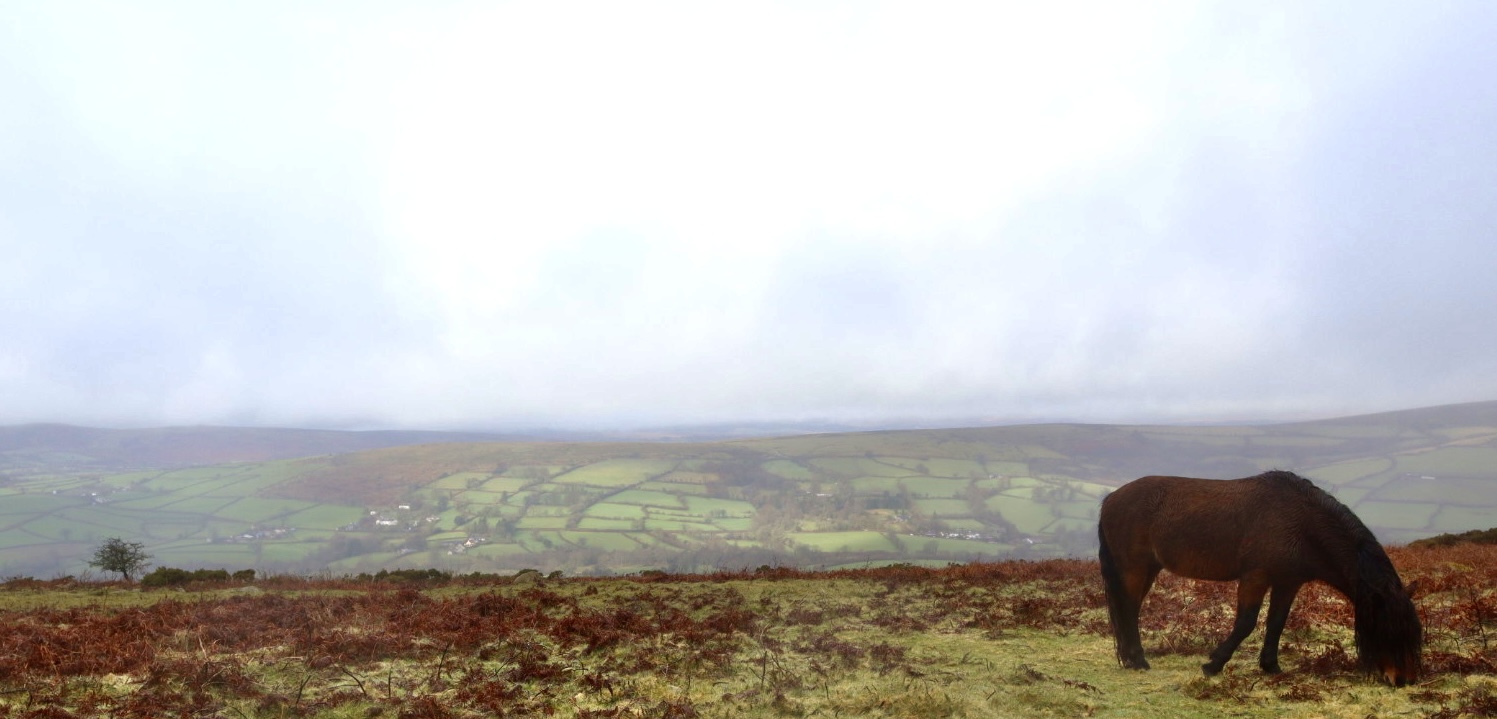
Continuing south, I eventually come to a well maintained path, that takes me round the base of Wittaburrow, and eventually crossing Ruddycleave Water at the Blackslade Ford. As I descend the hill on this path, past a flock of overly confident sheep that refuse to move out of my way, instead making me divert through the prickly gorse and tussocky ground that flanks the path, I hear a rather haunting, rough and squealing whistle in the distance. Having no idea what was causing this, other then it being a bird, I got my Merlin Bird ID App out and recorded the noise. The App did its magic and came up with an answer. What I was hearing was the call of a curlew, who had made the boggy, moorland ground around the river its home, giving a nod to the success of the Curlew Conservation project which began on Dartmoor in 2021.
Having forded the river, I follow the gentle slope uphill, for about 500m at which point, a non-descript, small path appear to the left. This path take me over a road, and as I follow its route, heading towards Buckland Beacon which stands in the distance, I glance over to the left and see a large, rhomboid shadow dominating the horizon. This is the disused rifle range of Halshanger Common. The range which was built in 1942 and was used into the 1960s, divides opinion. For some, it represents an interesting relic of our military history, for others, it represents a real eyesore on the Dartmoor landscape. Whilst I can see merit in the former, I fall firmly into the latter camp.
Heading across Buckland Common, I arrive at Buckland Beacon. The beacon, perhaps unsurprisingly given its name is a prominent outcrop located at the top of Buckland Common, overlooking Buckland-in-the-Moor, Holne Chase and Ashburton. The beacon was one of a number set up along the southern edge of the moor, which along with its sister beacons, was used to warn of the arrival of the Spanish Armada out in the English Channel, in a sequence I’m sure is reminiscent of the famous scene in Lord of the Rings.
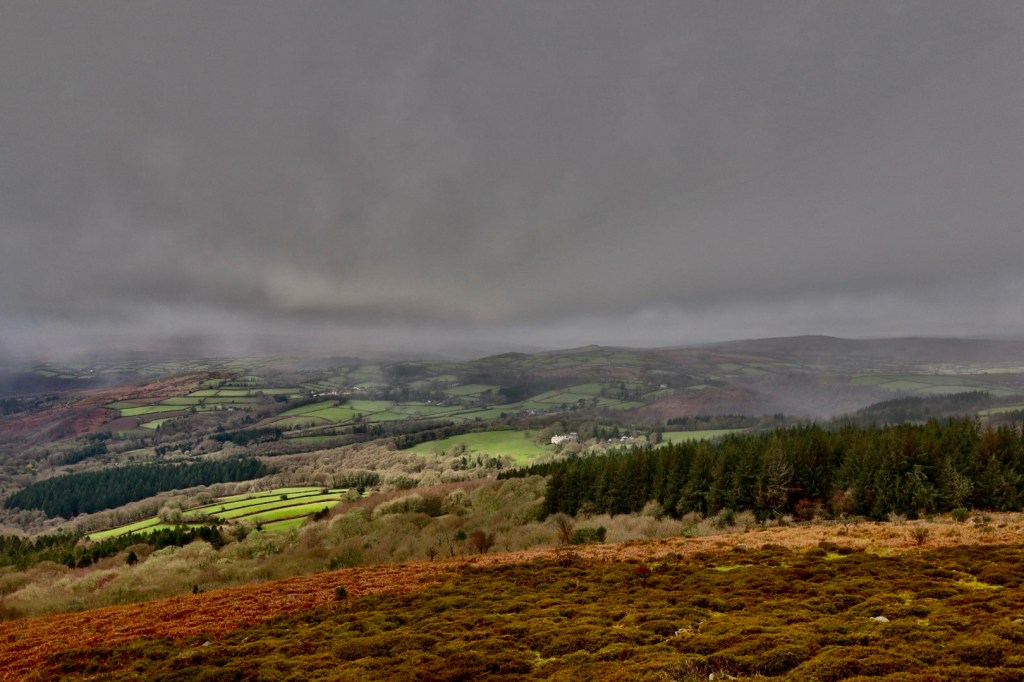
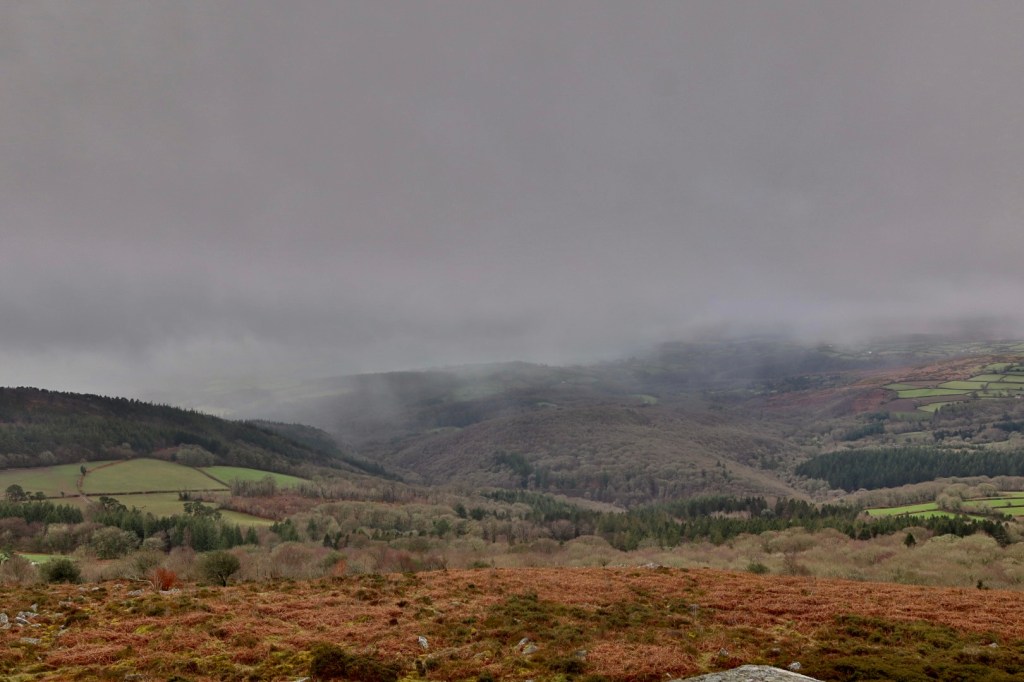
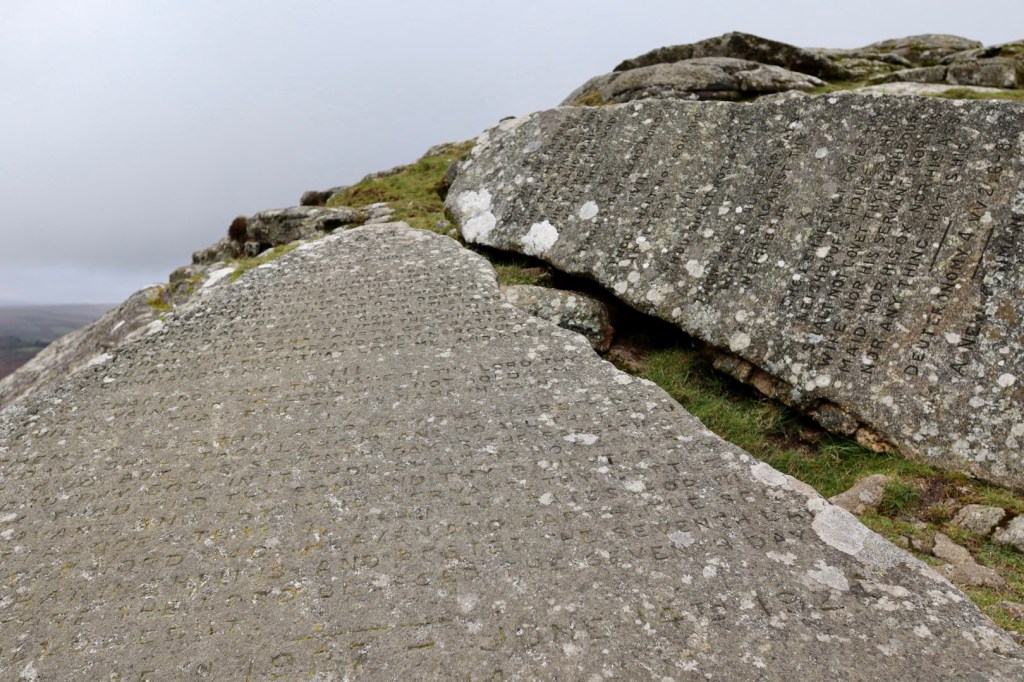
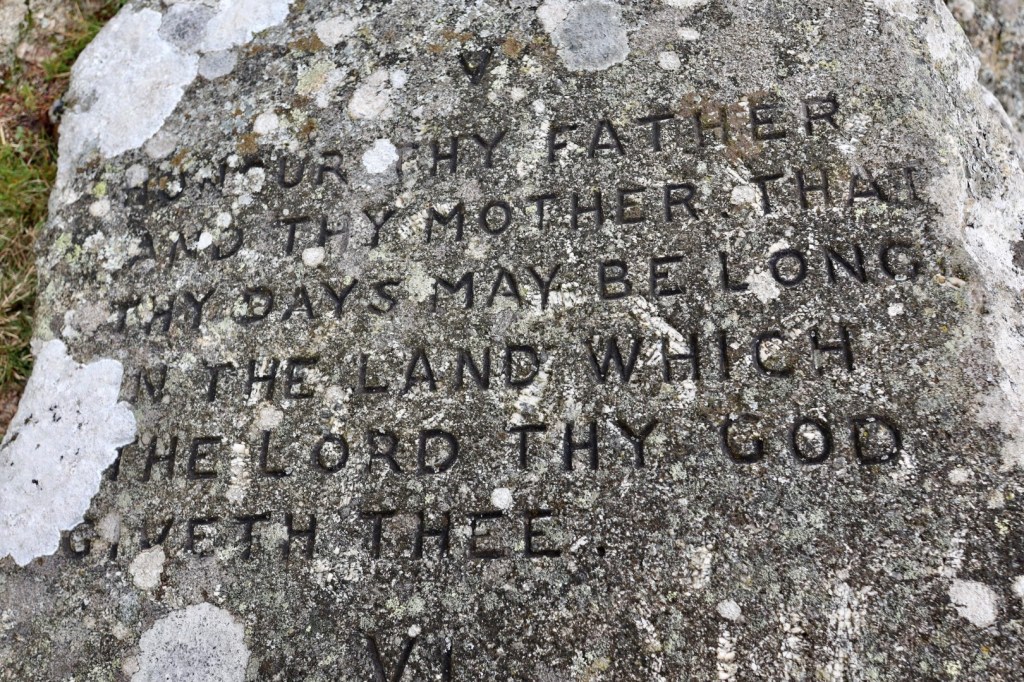
Whilst the beacon itself and the views around are impressive, the real star of the show round here is the Ten Commandment Stones. Now, you could be forgiven for thinking that the commandments were given on slopes of Mount Sinai, and that there were x10 of them. However, this is wrong, as proven by the presence of the ELEVEN commandments on two massive granite slabs the sit at the base of Buckland Beacon.
So how did they get here I hear you cry. Were they brought here on a holiday visit of the beacon by Moses? Was it transposed here by God/Jesus, to bring piety to the people of Dartmoor? Or was it one by a wealthy landowner in celebration of the rejection of the new Book of Common Prayer in 1928? It was the latter, with the stones being inscribed by the lord of Buckland Manor (William Whitely of Wellstor who after finishing his work was known locally as Moses) in August 1928. The eleventh commandment being added as a space filler. Over the years, the inscriptions have been restored, with the last effort occurring in 2016. Being exposed to the weather and countess visitors, on my visit the inscriptions are beginning to fade (which for someone who knowns generally next to nothing about the bible and the commandments makes reading them particularly difficult). Nonetheless, these stones have become as much a part of Dartmoor’s heritage as the ponies, the stories and the tors. Oh, the eleventh commandment – well, upon completion of the inscribing of the famous ten, there was quite a lot of space left so William Whitely divined that an eleventh commandment should be added. The commandment as added was “John, Chapter 13 Verse 34,” along with the third verse of the hymn, ‘Oh God Our Help in Ages Past’.
Retracing my steps along the path, I leave the 10 (11) commandments stone, and perhaps my last chance of salvation, behind and head onto the road. I follow this for about 400m, before ending up in a carpark. Opposite to this is a gate, which I take onto Halshanger Common. From here, I head North, straight up the hill, to the summit of Rippon Tor. This is the only partially tricky part of the walk, as it off path and therefore on open, tussocky and boggy moorland and gets steep on occasions. Rippon tor stands proud in the surrounding landscape offering views as equally majestic as the nearby and more popular Haytor and Saddle Tors. Rippon Tor, topped by a trig point, is surrounded by artefacts and remnants from prehistoric times and is therefore a great place for aspiring (or actual) historians to wander around.

From the top of Rippon Tor, I turn for home. Following the path that heads North-west from the summit towards Hemsworthy Gate, I do my best impression of a cow and stumble my way over the cattle grid (learning a lesson to take the gate next time to avoid looking like a moron), that leads me back to the carpark and my car.
| Difficulty | Distance | Navigation Required? |
| Easy with paths most of the route | 8.5km | Only in poor visibility |
| Start / Finish Point | Safety | Footwear |
| SX 741 760 | General Dartmoor Considerations Road crossings River crossing | B0 / B1 depending on weather |

 Moorland Ramblings
Leave a comment