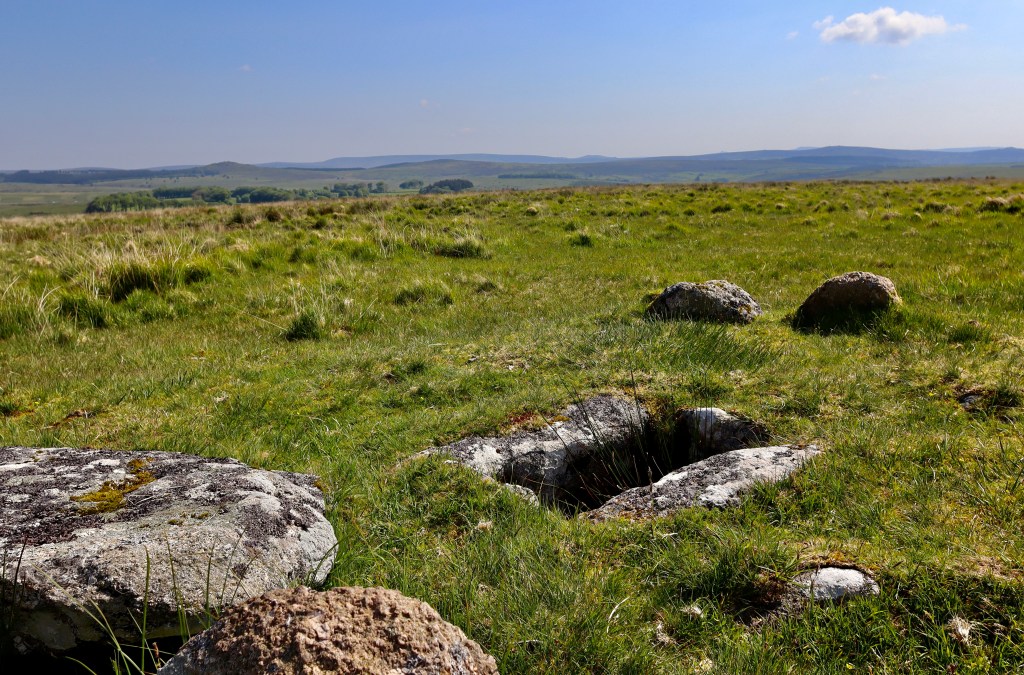
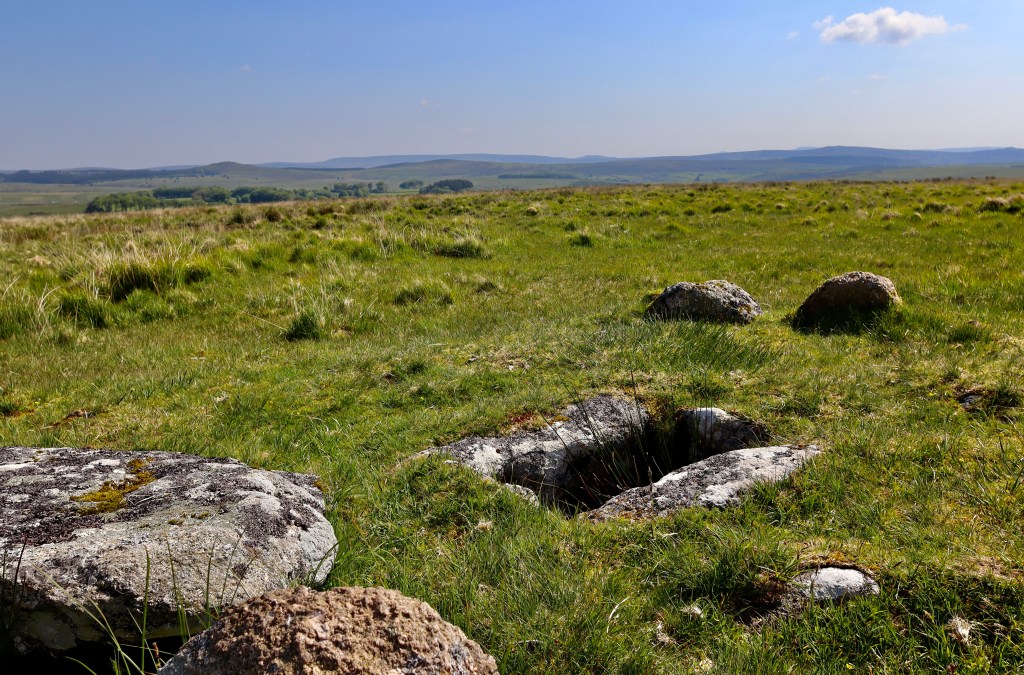
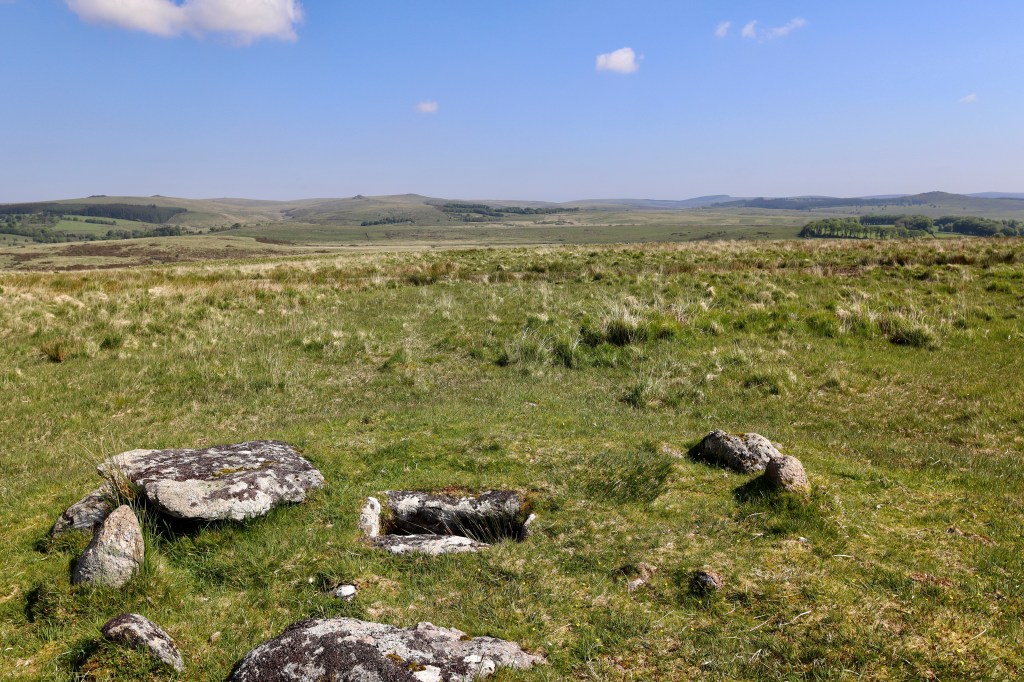
Southeast of Princetown, skirting the edge of Royal Hill, is the Dartmoor Way – High Moor Link. Just off the path, near the zenith of the hill is a fabulous example of a Dartmoor Cairn and Kistvaen. This one is special for many reasons. Firstly, it is in remarkably good condition (comparatively to other moorland examples), secondly, this is one of a few Dartmoor examples whose name actually appears on the modern Ordnance Survey maps and thirdly, and most importantly for this post, it has x2 fantastic stories associated with it. We are today talking about the “Crock of Gold”.
Luke Mudge
The first story relates to a local resident, a chap named Luke Mudge. Luke made nets in which rabbits could be caught. This was an honest job but brought in little money and what money he had he often spent in the local pub. With snow settling in the mid of winter, the beer flowed and the fire roared and this atmosphere naturally led to storytelling, with stories of the surrounding moors proving the most popular. Stories have the power to inspire caution, fear, bravery and a host of other emotions, but on this occasion, greed was the prevailing outcome.
It was well known that the path connecting Princetown and Hexworthy was dotted with ancient burial grounds. What was less well known however, was what these mounds contained. As the stories of ghosts and spirits went on, one local told of how he once found what he described as “base guineas”. Believing them to be worthless, he threw them away to be lost forever. However, his actions had caused him anguish, as he had subsequently heard of tales in which great sums of money were found within the kistvaens near Widdecombe and it was now his belief, he had thrown away a fortune. When asked if he had searched any of the kistvaens nearby to recover his lost found, he looked outraged, explaining this is not a sensible action that a cautionary tale that robbing a kistvaen was a sure way to have an evil curse laid upon you.
Luke left the pub that night fuzzy headed, with thoughts swirling and went home to eat a hot soup he had left boiling. Luke was soon to find that the combination of beer and boiling soup were no mix and burnt his hand badly. His injured hand was stubborn to heal and Luke was unable to work. With what little he had by way of money was getting smaller still and his thirst for the gold he now believed to be buried in the surrounding hills grew ever stronger.
Eventually, his curiosity, belief and desperation got the better of him and so one night, under the bright moon, Luke took the path from Tor Royal, stopping at the top of a hill by a kistvaen he knew well. He took an iron bar to it and removed the capstone, plunging his hand into the chamber to remove his prize. What he found however was broken pottery. Undeterred, he kept feeling around but as he did, he noticed the weather change. The clouds gathered, obscuring the moon and the temperature dropped. A sense of foreboding overtook Luke who decided to abandon his grave robbing adventure and return home. However, as he began to remove his hand, the capstone began to move on its own accord. Within the blinking of an eye, the capstone had replaced itself, with Luke’s hand and arm trapped underneath it. Howling in pain, Luke was trapped on the hill for days until the locals found a way to remove his arm and transfer him to hospital. Unable to work, Luke ended up penniless and destitute and his tale was used forever more to warn of robbing the kistvaens.
Jeremiah Toope
The second story is less about desperation and fear and more about kindness and hope.
Mr Jeremiah Toope was a kindly man, who has dedicated his life to education. His career had been a successful one and he had found himself the head of the (now closed) Ashburton Grammar School. Unfortunately for Jeremiah, whilst his mind remained sharp and passion for the job flourished, the ravages of time wait for no man and Mr Toope found himself losing his vision and hearing in his older age. As a result, without warning, he was dismissed from his role.
In order to find reemployment, Jeremiah decided to visit Mount Kelly school in Tavistock. This journey would take him across the moors, through Hexworthy and along the along the old track on Royal Hill to Princetown before ending in Tavistock.
His journey was undertaken in summer and the slog up Royal Hill, combined with the distance already covered and heat of the day took its toll. Jeremiah therefore sat by some rocks to take a well-earned break. As he sat quietly, reflecting on his journey and thinking on the potential job, he saw movement on the ground ahead of him. Dismissing it as an illusion caused by his deteriorating vision, Mr Toope continued on his journey. However, after just a few steps, he again saw a movement out of the corner of his eye and this time, he decided to pay it his attention. When he did, he found himself wide eyed and opened mouthed as what he saw, was a band of piskies running about the heather.
As he gawped at them, he noticed that the troop appeared flustered and on closer inspection, he saw what appear to be a Queen, in despair. Confused but intrigued, Jeremiah asked the closest piskie what was wrong and in reply, he heard that the Queen’s pet hedgehog had died and she was inconsolable. Having spent a career educating children, Jeremiah Toope was no stranger to consoling the inconsolable and so, with the permission of the piskie guard, he approached the piskie dressed in a flowing, emerald-green dress, and sat beside her.
Mr Toope regaled the piskie queen with tales of his youth, his journeys and his career, all the while cautious to avoid the topic of hedgehogs. As his stories continued, the Queen stopped crying and over time, a smile crept inexorably onto her face, turning into a chortling, giggling laugh as though all her troubles had lifted. As the now merry band of mischievous fairies left, the Queen thanked Mr Toope for his kindness and advised him to dig down into the kist (she would protect him from the evil curse) where he would find a token of her appreciation.
Once the piskies were out of sight, Jeremiah dug down into the kistvaen and within just a few inches, came upon a sack in remarkably good condition. Upon opening this sack, to his amazement, he found a stash of gold coins.
Having completed the majority of his journey, and flush with a new wealth, Jeremiah decided to treat himself to a night in a fancy inn in Tavistock. As he continued on his journey, he noticed his vision and hearing improve and whilst wondering on if this was another piskie gift, he soon found himself in Tavistock. The next morning, well rested, well fed and freshly cleaned and shaven, Mr Toope presented himself to Mount Kelly (his passion for education reached beyond his new fortune) and found himself a new teaching position.
He remained in this role happy, for a number of years, but his encounter with the piskies was never far from his mind. As such, one morning he excused himself from his fellow teachers, saying he needed to visit Princetown. He lef tin search of his piskie queen, saying he’d be back before evening. Well, evening came and went, as did the next day’s and the next. Mr Toope never returned from his journey and was never seen again. Some say he re-found his piskie friends and married the daughter of the Queen, living happily forever more (other, more cynical folk say he got lost in a mist and died of exposure, but that isn’t as heartwarming, even if it is likely more accurate).
I hope you enjoyed the above stories. To really bring them to life make sure you visit the location which is a couple of KMs south east out of Princetown. If you need any help with a walk, check out my post here The Crock of Gold – Princetown to the Crock of Gold


 Moorland Ramblings
Leave a comment