
Before I launch into the topic of the post, the cover image – WordPress has an option where you can use AI to generate an image based in the content of your post. I thought this one was amazing (having taken no photos of a Kamikaze lamb) so had to use it – skip to the end of the post to see the context for the picture.
I’m writing this post a few days after I took my Hill and Moorland Leader Assessment. I have allowed time for the adrenaline to settle, the reflection to complete and the mistakes to be (mostly) forgotten and so think I can now write this with a clear head. I wanted to write this post because when I was prepping for my assessment, I was looking around for info on what I could expect. All I could find (granted my search skills probably aren’t great) was advice from providers on how to prep for the assessment. Whilst this was useful, it wasn’t quite what I wanted. I wanted to know what it was actually like, what people were tested on, how it was run etc. Hopefully, this post may prove useful for someone preparing for their assessment (and interesting for everyone else).
Those of us who love walking, whether that be in the hills & mountains, snow laden crevices or along the paved paths of a popular walking trail, will eventually come across Mountain Training. The “about us” section of the Mountain Training website (https://www.mountain-training.org/about/) tells you all you need to know about Mountain Training.
“Mountain Training is the network of awarding organisations for skills courses and qualifications in walking, climbing and mountaineering that operates across the UK and Republic of Ireland. [They} set the standards for leadership, instructing and coaching qualifications, and skills training courses.”
Mountain Training oversee the awards of various qualifications that enables someone to competently lead others in adventurous activities. These are broadly split into two categories, Climbing and Walking. There are x12 qualifications within the “climbing” category, and x6 in the “Walking”. Of the walking qualifications, Mountain Leader is perhaps the best known, but it the Hill and Moorland Leader (HML) qualification that I undertook and will explain over the next few paragraphs. If you want to find out more about the other schemes, the Mountain Training website has a good guide on the qualifications here: https://www.mountain-training.org/qualifications/which-qualification-is-for-me/

Hill and Moorland Leader
When I first discovered Mountain Training, I found myself looking round the guide above. I had heard about the Mountain Leader award and went seeking more information about that, however, during my search I stumbled across the Hill and Moorland Leader section. Living and walking amongst Hills and Moorland, and not mountains, this instinctively felt more appropriate for me, but I did have one big old burning question – what is the Hill and Moorland Leader Qualification (HML) (see my seperate post about HML to give an overview).
The qualification encompasses x2 aspects, training and assessment. It is designed to support and enable keen hikers to lead hill walking groups in summer conditions during the day (additional qualification can be added to support overnight trips (e.g. the Camping Leader Qualification)). The qualification is only applicable for a Hill and Moorland environment and for an environment to be thought of a suitable, Mountain Training suggest the following four criteria are required:
- Open, uncultivated, non-mountainous high or remote country known variously as upland, moor, bog, fell, hill or down
- Areas enclosed by well-defined geographical or man-made boundaries such as classified roads (areas that merge with mountain regions and do not have well defined boundaries are excluded)
- Areas of remoteness that are easily exited in a few hours, returning to a refuge or an accessible road
- Areas where movement on steep or rocky terrain is not required (in either a planned or unplanned situation)
The truth is, even with the above, determining if you are walking in hill or mountain, or moorland or lowland still holds an element of subjectivity. When I was collecting my Quality Days (see https://www.mountain-training.org/help/frequently-asked-questions/what-is-a-quality-day/), I often asked the following question of myself, to see if I was in an appropriate environment –What would happen if I fell over?
It sounds a strange thing to ask, it probably is a strange thing to ask, but it definitely helped me because the answer pointed towards the terrain:
- Trip, fall to the floor, feel embarrassed and get on – Lowland
- Trip, fall to the floor, feel embarrassed and keep on rolling – Hill
- Trip, fall, feel an overwhelming terror and keep on plummeting – Mountain
I picked the qualification based on where I live, the ease of access to Hills and Moorland and a future eye on what I wanted to do with the Qualification (lead groups and teach navigation). I’m the sort of person that will make their mind up about something, and then get on and do it (as long as it doesn’t involve a phone call – that takes a bit more time). As such, I read about the qualification and signed up to it a few days later. My journey to becoming a qualified HML had begun.
Training and Consolidation
To register for the training, you first need to sign up to Mountain Training. This will give you access to all the courses they offer, and your Digital Logbook (DLOG), and you will need to have at least x20 Quality Hill Days logged. In addition, you need to be at least 18 years old, have at least one year of hill walking experience and be a member (club or individual) of a mountaineering council (British Mountaineering Council, Mountaineering Ireland, Mountaineering Scotland).
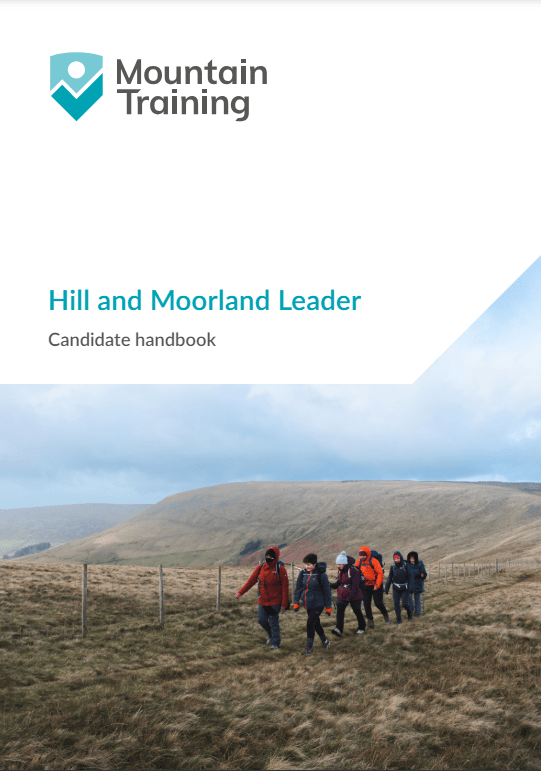
I undertook my training in April 2023. The training itself is great. It’s a three-day course in HML terrain. I did mine on Dartmoor and was joined by 6 other like-minded people and we spent three days doing the things we like – walking, navigating and learning new skills. The training is designed to teach you everything you need to know for assessment. My training covered all aspects of navigation (pacing, timing, handrailing, contouring, route choice, bearings and poor visibility navigation (night nav)), group management & leadership and emergencies and hazards. If I’m honest with myself, I didn’t really prepare for the training day. Preparation isn’t really required, but on reflection it would probably help to get more out of the three days. I think going in with questions about the syllabus etc, or going knowing what your weak areas are mean you can focus on them over three days – just one less thing to think about during consolidation. At the end of the three days, you are given feedback on your “performance” (you aren’t being tested but the trainer will keep an eye on how you’re doing) and areas of strength/weakness (I had to work on my contouring – I knew this so was no surprise) and we were given advice on how long our consolidation period should be.
Following training, candidates enter the “Consolidation” period. This is a that a candidate should use to meet the pre-requisites for an assessment. In addition to those above, you must have:
- Attended an HML Training
- Recorded a minimum of 40 quality hill days in at least three upland areas of the UK or Ireland
- Physically attended and completed (i.e. not online) a first aid course which involved at least two full days or sixteen hours of instruction and included an element of assessment (my background allowed me to self-exempt from this)
The consolidation period is fun. There is no time limit on it and no pressure from Mountain Training. Initially, I planned to undertake my assessment in October/November (i.e. 6 months after my training) which was supported by the trainer. However, due to health reasons I put this off and completed 12-months after training. Many other people take longer then this – it is completely up to you. Essentially, sign up for an assessment when you feel ready.
I used my consolidation period as an excuse to drag my family to beautiful areas across the UK. We frequented the Brecon Beacons and Lake District and also explored Bodmin Moor and Exmoor (as well as continuing to walk around Dartmoor). On my consolidation, I tried to practice those areas I needed to strengthen. This meant I was looking for contour features on maps, navigating to them and then using GPS to confirm if I was right or not. I also made sure I was enjoying the walks, an not just walking with my head in a map fixated on my attack points. This meant that come assessment day, I was happy to identify the feature I needed to (and know where I was based on the ground shape), decide a plan and then walk there whilst speaking with my group instead of just ignoring them. In addition, I walked as much as possible in poor visibility (sometimes rushing out the house as I saw mist settling on the moor) and at night, so I not only got comfortable, but confident in my nav abilities.
The Mountain Training Association (MTA – https://www.mountain-training.org/help/our-association/) also run a mentorship program. Whilst I initially registered for this, I didn’t pursue it (they mentor for a year, and originally I planned to complete in less than this and I was assigned a mentor in Lancashire, which wasn’t much use for me being in Devon). I have heard from others that they found the mentor program incredibly useful and so if you are reading this because you have just entered your consolidation period and want to know what’s ahead, I would encourage you to sign up for this.
I registered for my assessment when I felt ready. I had about 60 Quality Days at this stage, so potentially could have booked on a earlier date, but I wanted to go to the assessment as well prepared and as confidently as I could. The build up to and assessment days are nerve wracking, and feeling confident in my skill was vital.
The Assessment
So then, the main shebang, the assessment. I guess the first thing I should say is “Don’t be nervous” and “Enjoy It”. Now, whilst both these statements are true, I’m not going to say them. Nerves are a good thing. They show you care and can help sharpen your mind to get you the result you want. On reflection, I did enjoy my assessment. I met some great people and spent three days tramping about the moors. But I would be lying if I said I enjoyed the experience at the time – I didn’t. It was mentally and physically draining and this is the first thing I want to say. It is DRAINING. I wasn’t prepared for this and I wish I was – I could have prepped myself for it.
The assessor want you to pass, that’s true. But they want you to deserve to pass and to be competent leaders. This means you will be tested. You will be tested on all areas of the syllabus and in particular navigation. As an HML you need to have a level of navigation skill that is over and above the casual weekend walker. As an HML, you (and therefore the assessor) need to be confident that you can navigate your way in and out of trouble, safely and effectively. Therefore, your nav will be tested throughout your assessment. On my assessment there were x4 of us. We would each be given one leg to lead at a time, but whilst the “leader” was given the location, no one else was. It was expected that the leader take us there (testing route planning and navigation) and the others would then show where we thought we were at the end of the leg. IN this way, the assessor could test the navigation and route planning skills of the leader but also the navigation skills of the rest of the group.
On day one we each led 4 legs, on day two (during the day) we each led 3 and then 2 at night (myself and one other candidate led 3) and on day 3 we each led 3. Therefore, in total we were tested on 50 legs of navigation. There were two things that made this hard. Firstly, the navigation itself. Moorland and hills are often pretty featureless and therefore navigation is to and between contours only. This is hard as a one off but the concentration required to do this over and over and over should not be underestimated. Secondly, we were never told if we had gone to or identified the correct locations. This meant I (and according to my fellow candidates they did the same) spent three days questions every turn I made, every distance I paced and every re-entrant/ knoll I stopped on. The self-doubt was overwhelming at times but this approach is intentional. It test you in the toughest of conditions, when you are fighting yourself and honestly, now that it’s over I can say that I am a better navigator for it.
Whilst the mental effort may be hard, it is true that you get out what you put in. I had a great group and a brilliant assessor. We all got along easily and so spent most of our time walking chatting away about all sorts of crap. This seems natural, but at the end the assessor let out that it is also intentional. Not to put us at ease in each other’s company, no. It is another test. If you are able to lead a group to a location, or know where you are at all times, whilst be distracted by talking about the surroundings, or work, or football or whatever else it might be, this demonstrates your skill as a navigator and ability as a leader. And it was fun.
Day two is host to the dreaded night navigation. This meant a late start on day two (we met at midday) but a late finish (we finished at midnight) too. The format is the same as the day nav (although we were given specific features), with one candidate leading and the others following and then identifying the location at the end. It was my first night nav leg where I screwed up. Instead of turning left onto a road and then pacing right onto a path, I turned right onto a path, and then paced right onto (another) path. I ended up in completely the wrong location and whilst I think I knew this, I doubled down on my mistake and tried to justify it. When the assessor asked if I was sure, I realised what I had done. A lot of swearing followed by me hastily leading my group to the correct location (and therefore rectifying my mistake). This played on my mind the rest of the evening, and actually I couldn’t sleep think about my error. I was sure I had failed because of it but again, all I could do was keep going.
The final morning was more chilled. We retraced our steps from the night nav exercise, confirming where we had (and hadn’t) been and as a group, talking about what we would have done differently. We then met in a café for breakfast and talked over the “home paper”. This is a list of questions we were sent x2 weeks prior to the assessment. The questions aren’t too taxing (especially as google is a thing) and cover things you should know as an HML. We worked through the paper as a group and this also gave an opportunity to learn from each other and demonstrate our teaching abilities.
After breakfast, we went back onto the hills and did some more nav. Whilst doing this, we also went over emergency scenarios and answered questions about the surrounding flora and fauna (pointing out mosses, lichens, flowers and animals). At the end of the day, we met around a car and were each given our results. This was done in private and honestly, you could cut the tension with a knife. None of us knew if the others had screwed up or not, but we each knew of mistakes we had made and we all thought we would be failed or deferred for this. None of us were. Each of us had passed and in the debrief, we were told that it wasn’t even close. We had each smashed it, despite some small mistakes and the relief was plain to see.
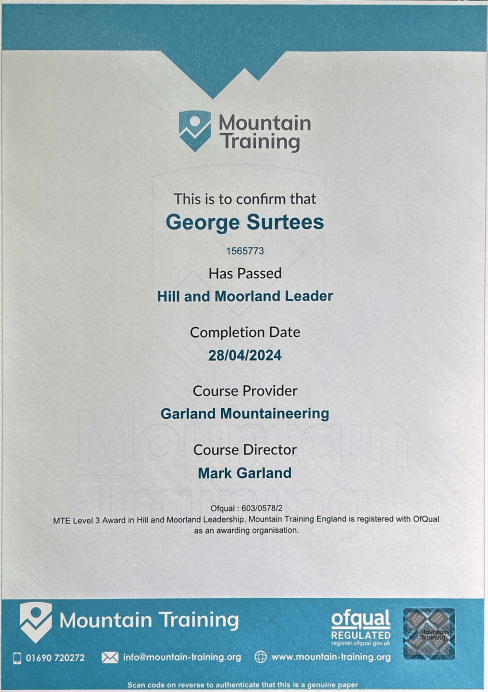
The debrief taught me two things. Firstly, be honest if you make a mistake. Everyone does, all the time, including people who have been doing this for decades. The skill of a leader is not in being faultless, it is in recognising error and weakness and correcting this in as quick and efficient a way as possible (hence why my night nav mess up wasn’t terminal). Secondly, be confident. You have done the training, you’ve done the quality days and this is something that should be a passion and those relentless hours on the hills in the build up to the assessment have had their effect. Very few people fail. Very few people are deferred. The vast majority pass and this is because of the hard work that has gone into the preparation. Be confident and do your thing.
If you’re reading this because your assessment is coming up then yes, be nervous. Yes, prepare for mental exhaustion (I didn’t even feel like this through the final run of my medical exams) and yes, prepare for self-doubt and uncertainty. But be honest, be thoughtful and be CONFIDENT.
Best of luck – you’ll smash it.
Oh I forgot – the title picture of this post! Just to prove that anything can happen on your HML assessment, and that as a leader you need to be prepared for anything, on my last leg. The very last leg I would be leading on my assessment and likely my easiest leg of the three days (handrailing a river onto a stream which took me into a disused mine) a lamb, that couldn’t/t be more than three days old decide to charge at me – from the other side of a river. It was running at me full pelt, bleating wildly and reached the bank of the river where it took off into the air, four legs splayed wide, flying like a majestic animal through the air, and then crashed into the river. Panick ensued and the group turned from nervous candidates into a kamikaze lamb rescue party. The lamb was fine and we all passed. A good day in all.
 Moorland Ramblings
Leave a comment