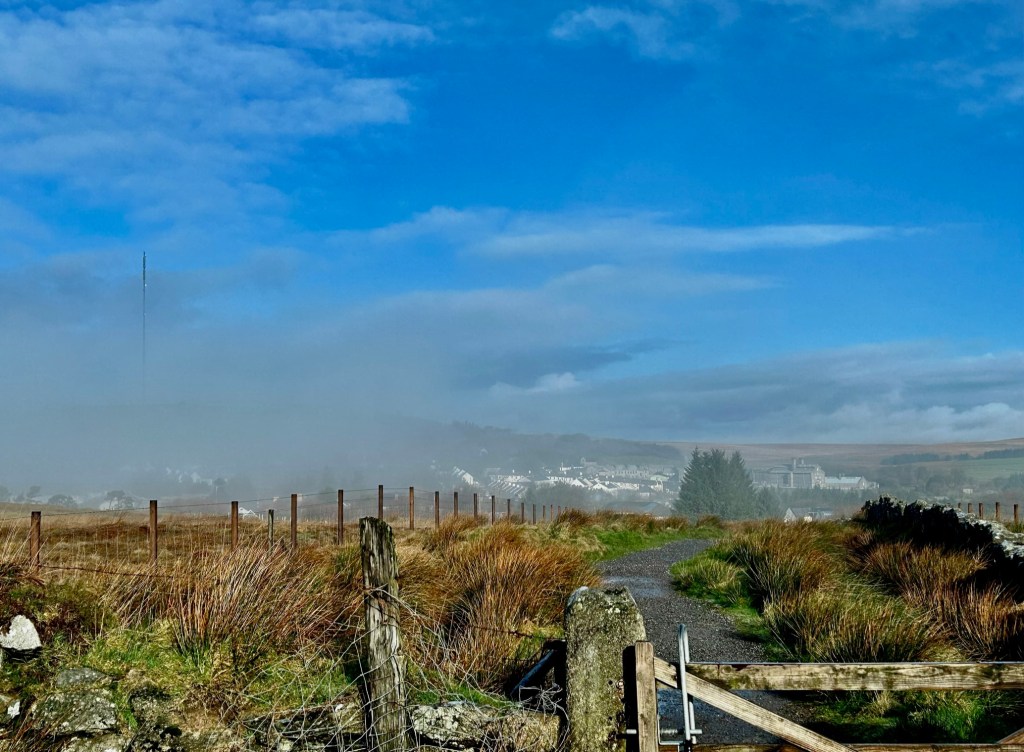
This is a 10km circular that included the best of all Dartmoor has to offer. History, folklore and ghost stories, environmental stewardship and water… lots and lots of water. I’ll try and do it justice over the coming paragraphs but honestly, this is one that you have to do.
I’ve done variations of this walk lots of times. I’ve done it by myself, with my HML group, with a family group and with a two year wriggling in their carrier on my back – testament to the gentleness of the route, which also has loads of spots where you can sit and rest and very importantly, there’s two great pubs to finish the walk at (or start at if you really want… or for that matter sack the walk off and sit in them with good food and drink – I certainly won’t judge).
As ever, the walk starts with a car journey. I get to Princetown (which is great – I’ll cover Princetown and in particular the prison at some point later on) and park in the public carpark there, which has recently been done up to include some electric charging points – demonstrating the ever-evolving nature of Dartmoor.
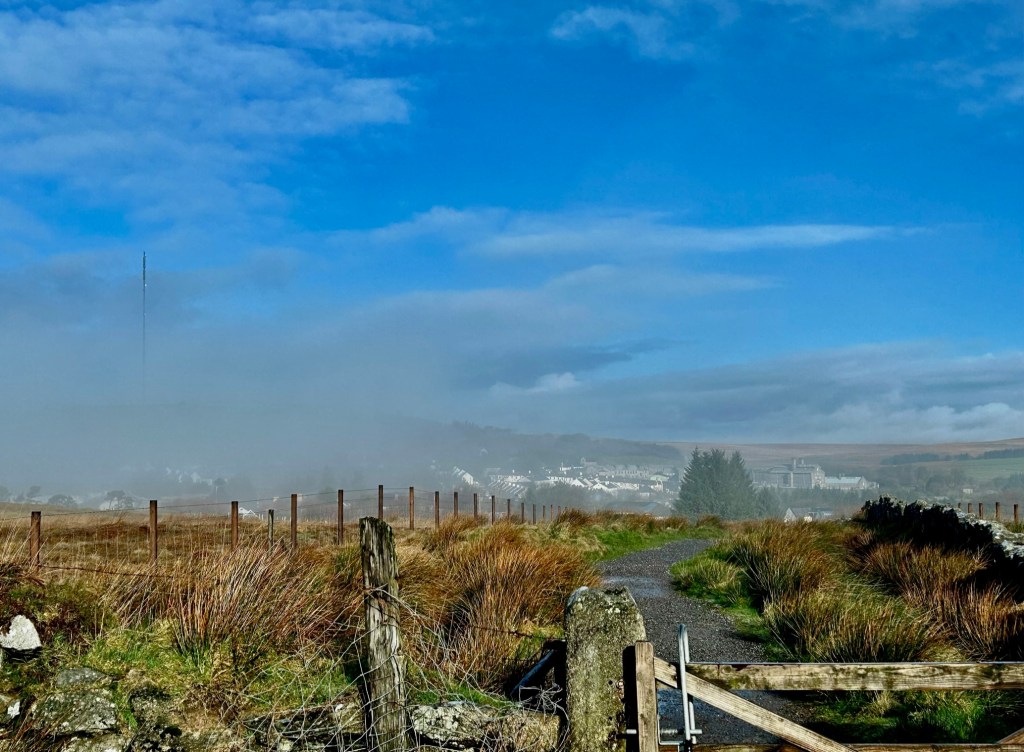
You start off on the path towards South Hessary Tor, which can be found behind the reopened Plume of Feathers pub. I set of in bright sunshine, and by the time I’ve walked the 0.5km and gone through a gate taking me onto the Moors, the famous Dartmoor Mist has started to descend and settle over Princetown and the lower aspects of the Moor. This makes for some truly stunning views, with the sun trying to fight its way through, but it’s an ominous sign for the walk ahead – changeable weather is feature of Dartmoor that is unavoidable but incredibly annoying.
Peat restoration
As I make my way along the path to the first Tor on my journey, I see a couple of excavators dotted around the area. My instinct is that this is to do with the Peat Restoration project being undertaken on the Moors, and my instinct is confirmed by some fairly non-descript signs pointing to the work being done. Peat restoration sounds boring but it really isn’t, and it’s incredibly important so I do want to spend a few sentences covering it but will do so in a seperate post – understanding peat.
South Hessary Tor
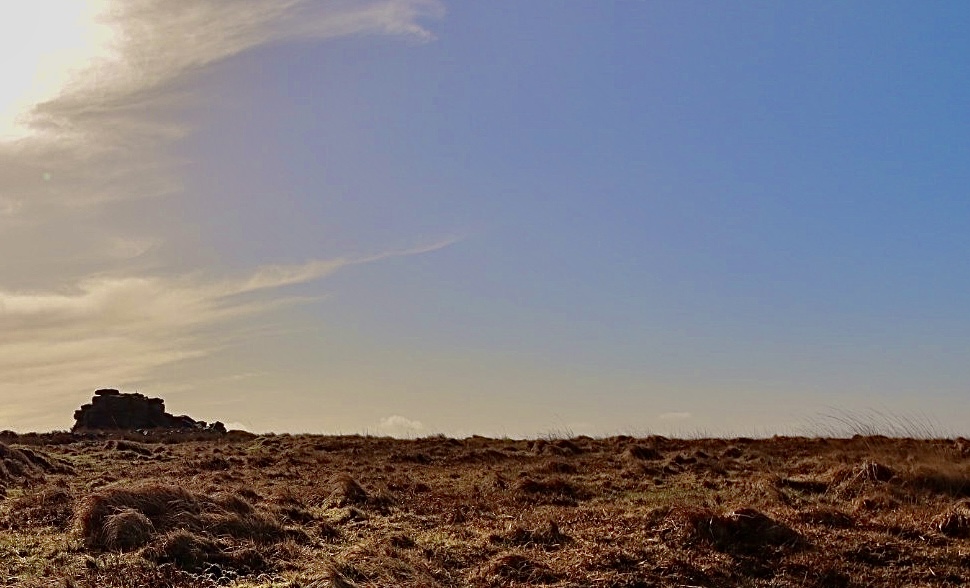
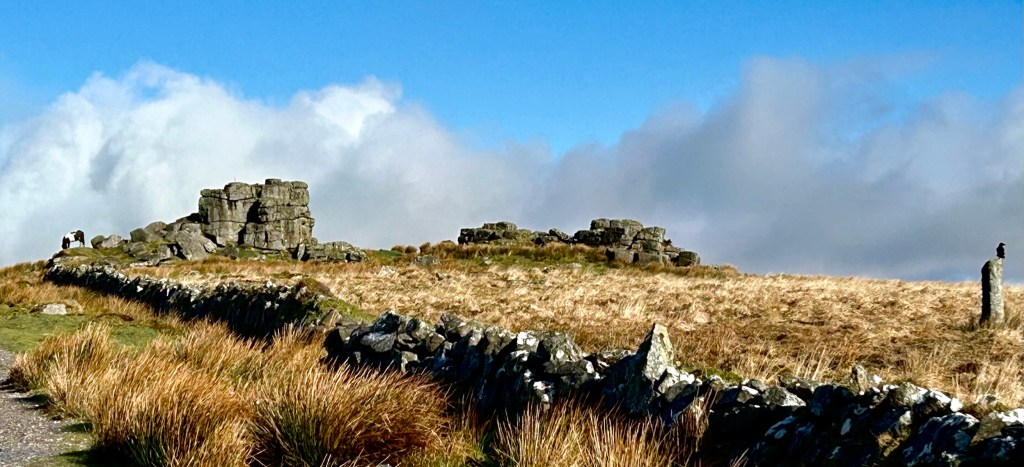
South Hessary Tor sits alongside the path. The Tor itself is imposing if slightly unimpressive (in my opinion) although I will admit the churned-up grass/mud within which it sits is possibly souring my opinion. The area in which the Tor sits however is full of interest however, mainly down to one man.
The area around South Hessary Tor was Tor Royal Farm (the Tor itself is sometimes known as Tor Royal as a result) which was established in 1785 by Sir Thomas Tyrwhitt. Sir Tyrwhitt is in himself a man of interest, having served as a Member of Parliament on three separate occasions, for Okehampton, Portalington and Plymouth, becoming Black Rod upon his retirement from frontline politics. In addition to his political and farming exploits, he also served as private secretary to the Prince of Wales and established a prison to house the prisoners of war taken in the Napoleonic wars, a prison that is today known as HMP Dartmoor. It is because of Sir Tyrwhitt’s service to the Prince of Wales (later King George IV) that Princetown gets its name.
Siward’s Cross
Continuing southeast along the track from South Hessary tor opens up views across the common land that is both far reaching and awe inspiring, demonstrating in picturesque beauty the wildness that Dartmoor is known for.
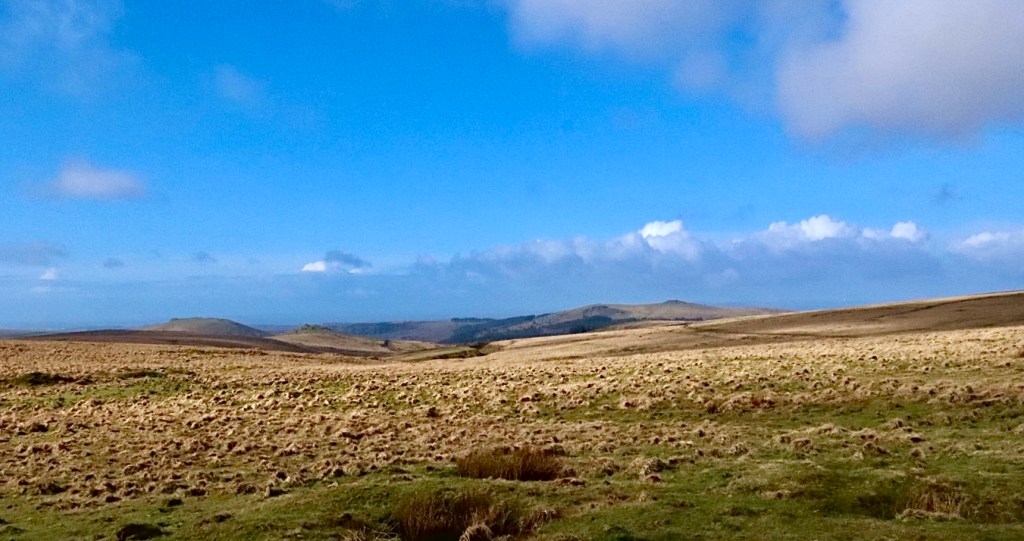
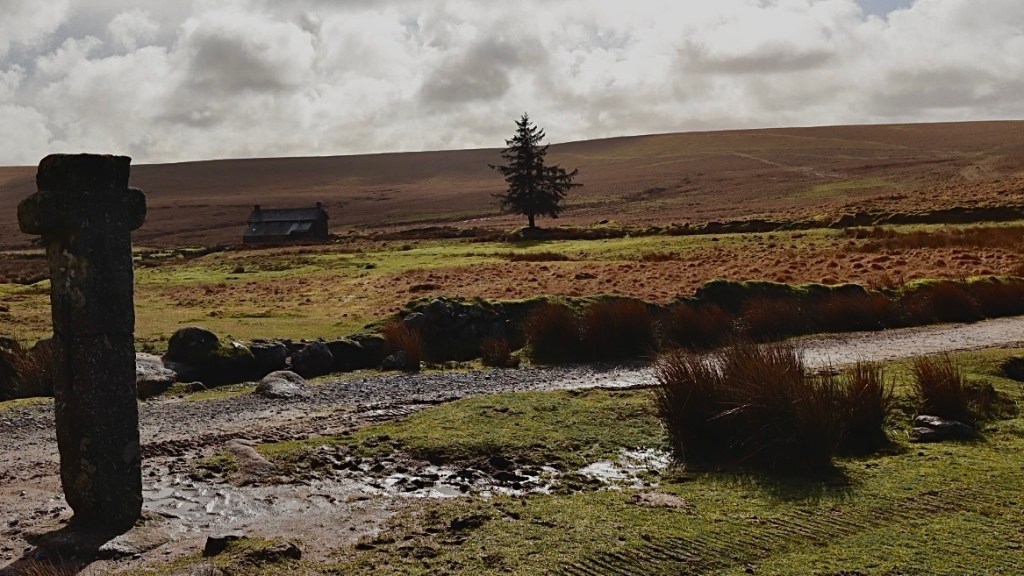
This track brings you gently downhill, eventually cresting a brow which brings into view both Siward’s Cross (also known as Nun’s Cross) and the farm to which it gives its name. At times it can feel like all paths on Dartmoor lead here, as it is the endpoint for tracks from Princetown, Whiteworks, Ditsworthy Warren and Meavy. More than this though, a path from Holne (a close(ish) village), a path from the close(ish) Eylesbarrow Tin Mine and the Monk’s Path and Abbott’s Way (see separate post) all converge on this point. It can be taken therefore, that this location is seen as particular importance in the history of Dartmoor.
This cross however, the oldest and (one of the) largest on the moor, the subject of many a photo and legend and often overlooked for the haunted farmhouse it neighbours, existed long before those pathways were thought up. The cross first appears in the Perambulation of 1240 and therefore, we know a cross to have existed here from before this date. On the eastern side of the cross, between the arms, is the inscription “Siward” (some note it as Syward) which gives the cross its name. This leads me to a question – who the hell is Siward?!
A bit of googling post walk has taken me through several options, but the most common seems to be that Siward was a Scandinavian warlord, who came to England after the conquest by Cnut, and was named as the Earl of Northumberland around 1041 (by murdering he incumbent earl). During his tenure, he provided support and counsel to King Edward (the Confessor). It is through this relationship, that Siward witnessed the signing of Exeter’s founding charter in 1050 and became Lord of the Manor at Tavi (likely Mary or Peter Tavy). It is for this reason, it is thought, that an Earl of Northumbria had lands that were marked by a cross on its boundary.
Why was the cross erected in the first place, however? Well, once again google is my friend (although I had already guessed at its initial intention). It is likely that the cross was originally a way marker for monks travelling between the abbeys of Tavistock and Buckfast (hence being on the Abbott’s Way). As an aside, since the abbey in Tavistock was founded after that of Buckfast, in AD960, and the cross marked the route between the two, AD960 is the likely earliest date for the cross being sited (and in my completely uneducated and in no way expert opinion, I would have through the cross was erected very close to the completion of Tavistock Abbey in AD960).
Nun’s Cross Farm
Sitting in the cool of the surrounding hills, with only Siward’s cross and a couple of conifers (and to be fair an abundance of wild campers and ghost hunters) keeping it company sits the long abandoned, desolate, Nun’s Cross Farmhouse.
The house was built-in 1870 by a farmer named John Hooper. The ground on which it sits is featureless, expansive and wet (and it has rained every single time I have visited, which is a lot. Every. Single. Time!). Mr & Mrs Hooper lived in the house whilst farming cattle on the surrounding hills. Following their deaths, a succession of families owned the house which was abandoned somewhere between the 1920s and 1940s. After this, the house fell into disrepair and dilapidation. It is now owned by the near-by Mount Kelly school and can be rented by the night for anyone seeking ghosts or a bunkhouse that is more substantial than a canvas covering can provide. Set as it is in an eerie backdrop, it is easy to see why the ramshackle building with its boarded-up windows conjures up imaginations of ghost and evil beings. As ever with Dartmoor, where a point of interest exists, so does a story and with Nun’s Cross farm, that story is one of death, grief and hauntings.
One night (sometime after the Hooper’s had tenure at the farm ended) with a mist settling in the basin of the hills, the wife of the farmer of Nun’s Cross was woken by the low, bellowing cry of a cow in trouble. Not content to leave her livestock to die alone in pain on the hill, the farmer’s wife woke from her slumber, and shaking off the last vestiges of her sleep, set out into the night in nothing but her nightgown and moth worn coat.
On waking in the morning, the farmer found his wife gone. Immediately a sense of dread started to rise. He knew of the calls that led people to their deaths so often on the moors and with the weather as it currently was, he knew his wife stood little chance. A search was started but returned nothing. To this day, those who stay in the farm report hearing the cow bellow, with subsequent footsteps in the house. Some even report ghostly, wet footprints even when the sun is shining (an admittedly rare occurrence in my experience). The farm has been reported as the most haunted house in the UK (again accepting that this titled is claimed by a number of locations) as a result of stories like this.
Crazywell Pool
To get from the farm to Crazywell Pool, you have two options, use a map and compass and cross the open Moorland or double back on yourself and follow the path for about 0.5km, after which a path to your left should become clear. Take this path to the pool. En route to the pool, you will pass another two crosses, one overseeing some disused tin working and the other overseeing Crazywell Pool itself. This route offer views over Burrator reservoir and the Tors that are scattered across Walkhampton common. Taking this route, you can’t help but find yourself marvelling at your surroundings and for me, I think back over the history that lays all around and the lives of those who have called Dartmoor home.
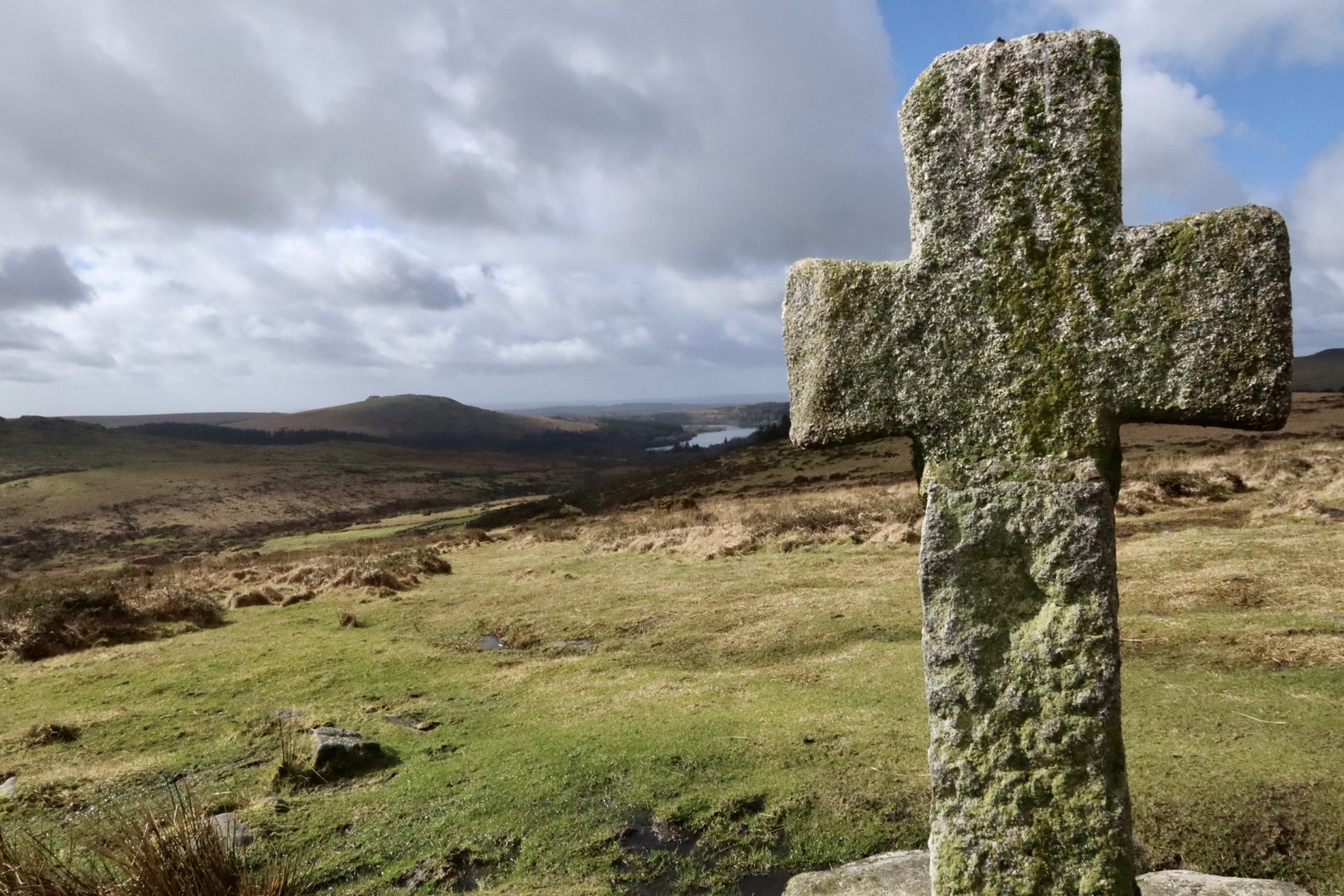

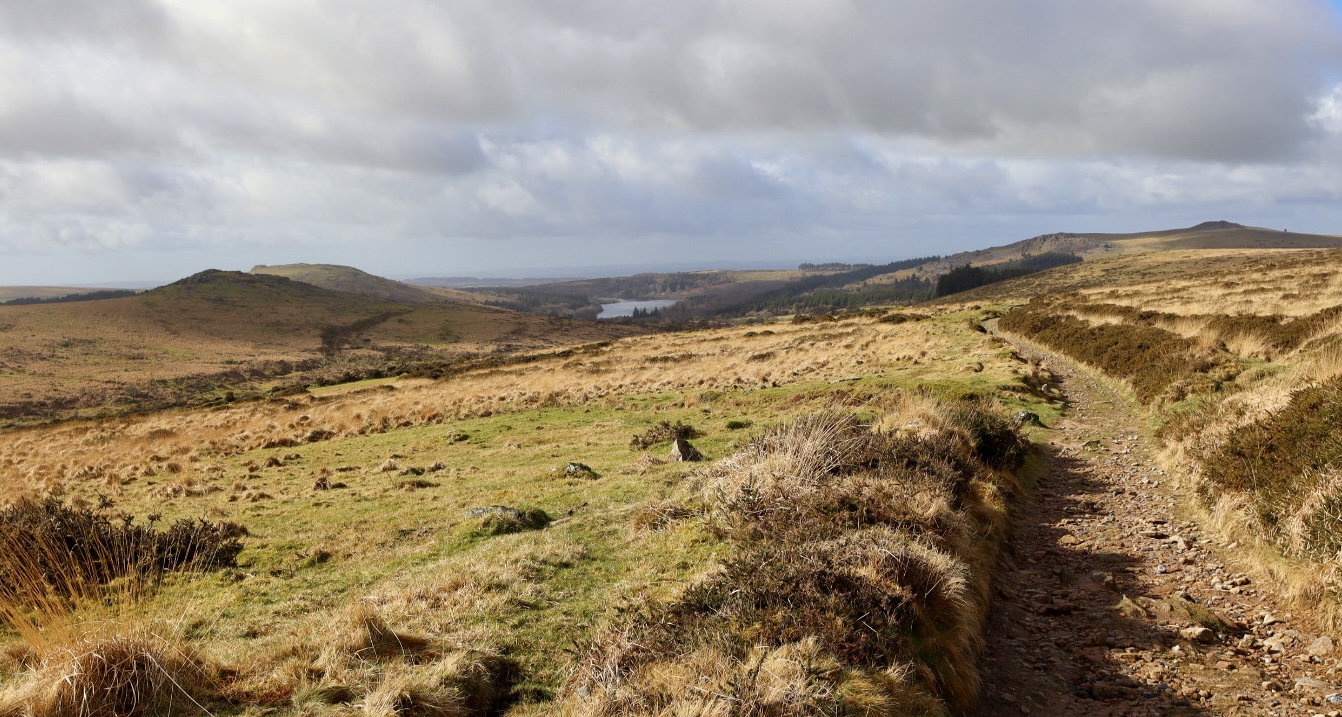
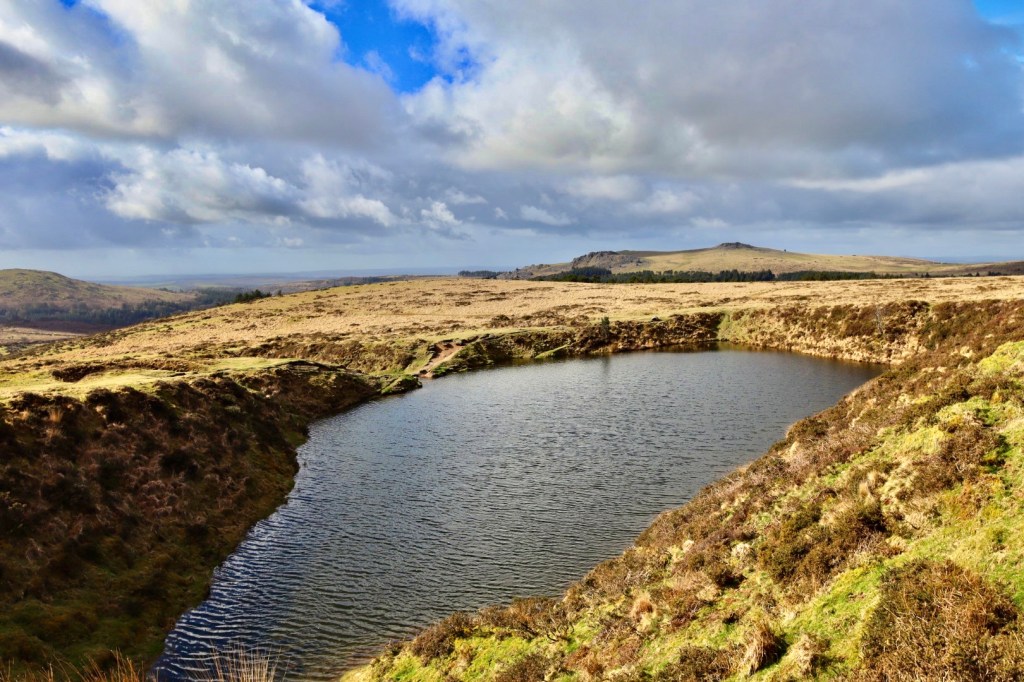
The pool sits high in the moors but is hidden away from view until you are almost on top of it. The pool is a source of numerous legends from the Moor, including the (now debunked) myth that it is bottomless and that the depth of the pool rises and falls with the tide at Plymouth Hoe. The three most famous stories however, all involve death (I’m sure you guessed that based on the title of this post) and I cover them in my post “Crazywell Pool: Myths and Legends of the Haunting Moors“.
Returning Home
From the pool, with all these delightful stories in my head, I handrailed Devonport Leat and crossed the Aqueduct. Turning right at the aqueduct, I followed the River Meavy until I found a crossing (a wobbly, flimsy metal sheet that took more nerve to cross then I dare to admit) which took me to a stone row shooting me out onto Hart Tor (I will cover the tales of this part of the route in a separate post). From Hart Tor, there is a clear path Northeast that takes you to the B3212 and back into Princetown, where a well-earned pint from the Dartmoor Brewer (again, will cover in a separate post) and pulled pork burger (just trust me – if you’re around you have to have it) at the Prince of Wales pub awaits.
This walk covers so much of what is great about Dartmoor – History, Folklore, engineering miracles (the leat and aqueduct) and views that inspire – oh, and peat, fog, and rain!
| Difficulty | Distance | Navigation Required? |
| Moderate – requires decent fitness | 12.5kms | Yes but mostly paths |
| Grid Reference | Safety | Footwear |
| Start and Finish SX 589 734 | Care on crossing rivers Uneven terrain General Dartmoor Considerations Ghosts | Walking boots or shoes (a few ankle turners on the terrain) |


 Moorland Ramblings
Leave a comment