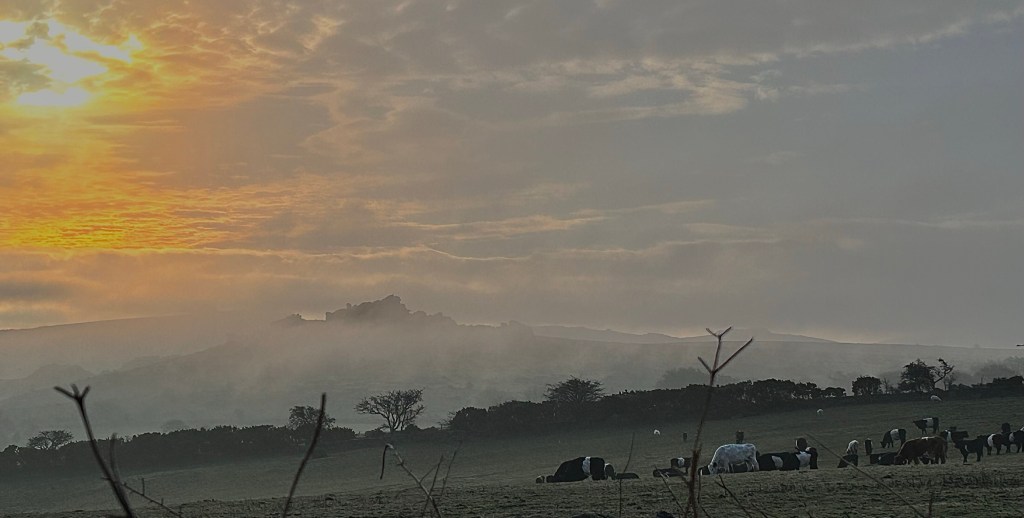
Hound Tor is one of the most well-known and visited Tors of Dartmoor, and it is easy to see why. It’s easy to access (by car), has easy routes up to the rocks, and is spectacular; both in their appearance and their offer of panoramic views of the surrounding countryside.
This walk, however, takes in more than just the granite that inspired Arthur Conan Doyle’s classic “The Hound of the Baskervilles” – it also invokes folklore, history and sombre reflections on past behaviours that may not feel as distant as we’d like.
The walk begins at the Car Park at the base of Hound Tor. Due to its accessibility, the car park gets busy, and an awareness of this meant an early start was ahead (although that is easily facilitated when awoken at 0530 by an excitable toddler). The view from the car park draws the excited hiker along a clear path to the top of the aforementioned Tor, but, in starting this walk I need to fight instinct and instead turn away from the rocky outcrop, turning north west and onto the main road (the use of the word “main” here is overly generous as the whilst the main route in and out of the car park, the road itself is pretty quiet).
There is an immediate path on the right, which would take you to Bowerman’s Nose but this is not the route I take. Instead, I continue past the hard-working farmer who I very quickly find out (by the overpowering smell) is moving his silage around. Mercifully, the smell is somewhat dampened by the light rain that is falling and so as I continue up the road, I leave the smell and noise of an ageing tractor behind. Ordinarily, you can walk on the relative safety of a grass verge but given the recent hammering of rain, which has been falling in a never-ending deluge recently, the grassy verges look more dangerous than welcoming. As such, I stick to the asphalt, turning from our bearing only for the occasional car, or more frequent pothole.
Sticking on this road for about a km, passing the sheep with their early lambs and taking in the views over Hamel Down, you come upon an eerie site. Sitting at a crossroads, rising over the muddy ground, evergreen from the grass and flowers that adorn it, is a poignant grave. Marked at the grave’s western end by a stone, acting as a head stone, local legend tells that this grave belongs to a young woman called Kitty (or Mary) Jay. I’ve written the story of Kitty Jay separately and it is well worth a read but be warned, it is not a light-hearted romp through the history of Dartmoor but is instead a sad reflection of the attitudes held towards those of a different class, and women, in the late 18th and early 19th century.

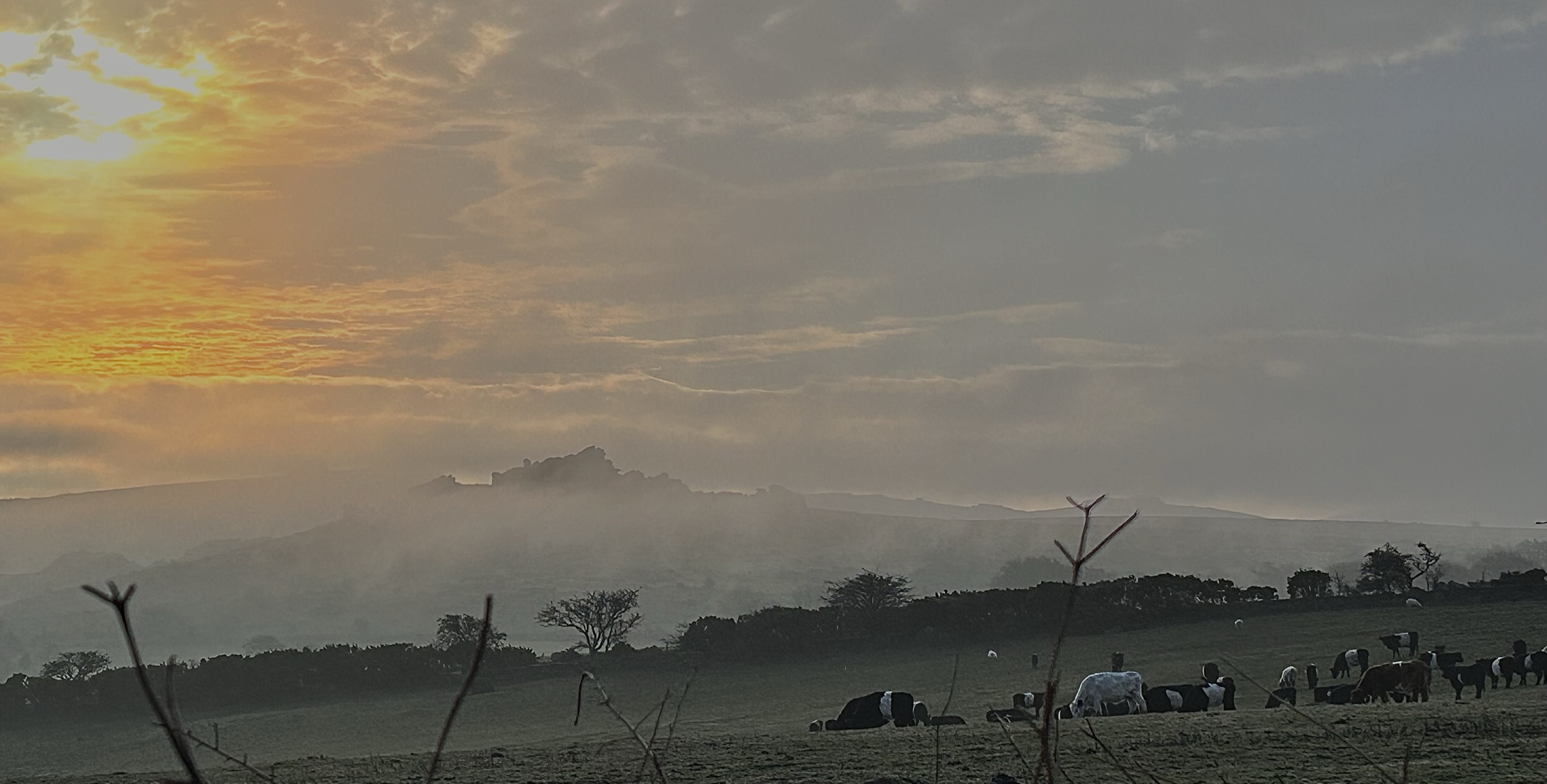
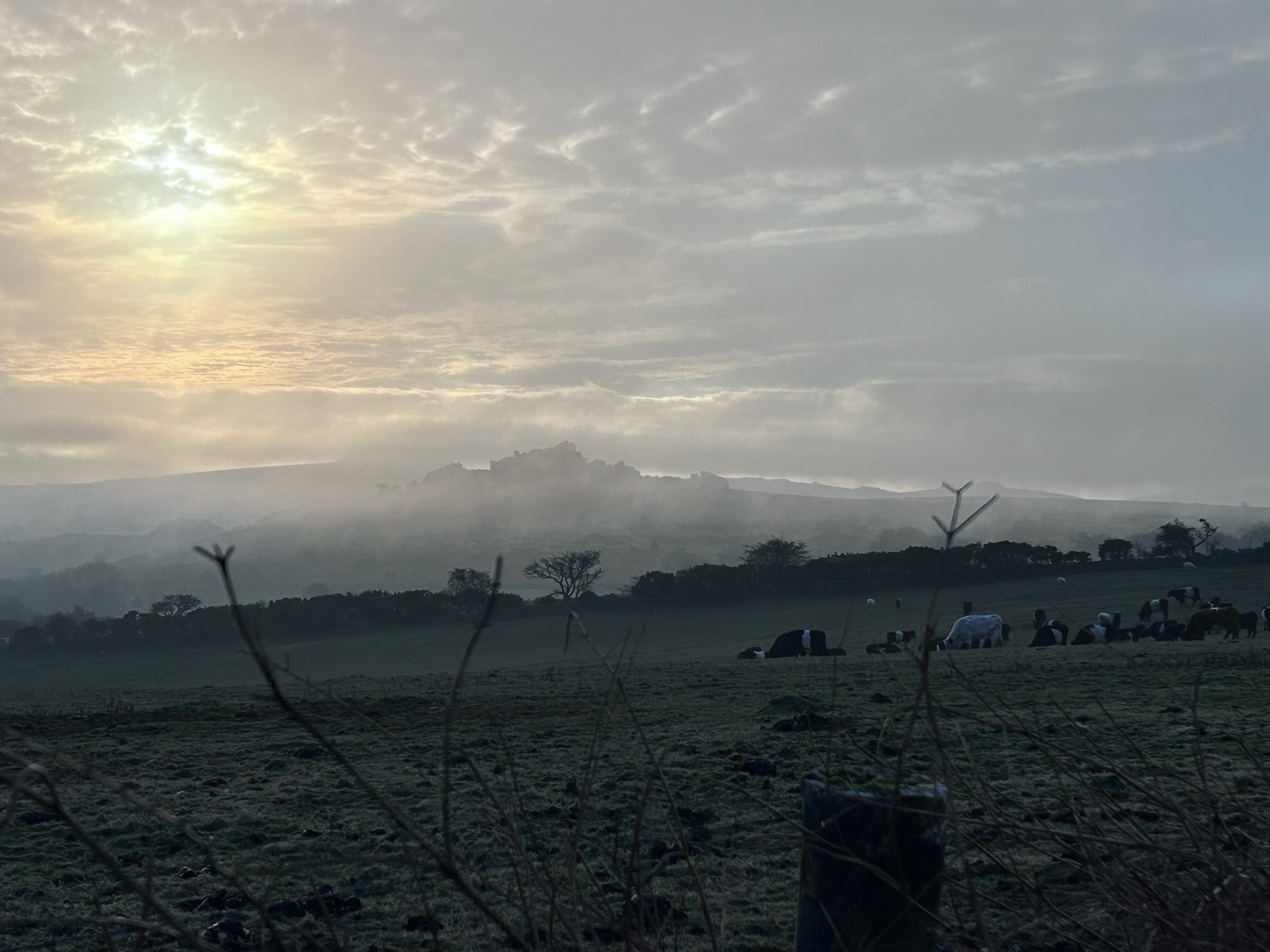
Directly opposite the grave is a path, which takes you gently uphill over Cripdon Down (be sure to keep the fields on your right, and don’t enter them, lest you want to disturb a flock of pregnant sheep or broody cows). The short ascent takes you to views over the nearby farm, Hound Tor, Greator and Smallacombe Rocks. It is here that Dartmoor shows off its best; with the sun fighting its way through a mist that has descended as quickly as it will disappear, offering a truly magnificent blend of mystery, colour and the inexorable march of nature. This sight alone makes the early start and constant donning and doffing of waterproofs worth it.
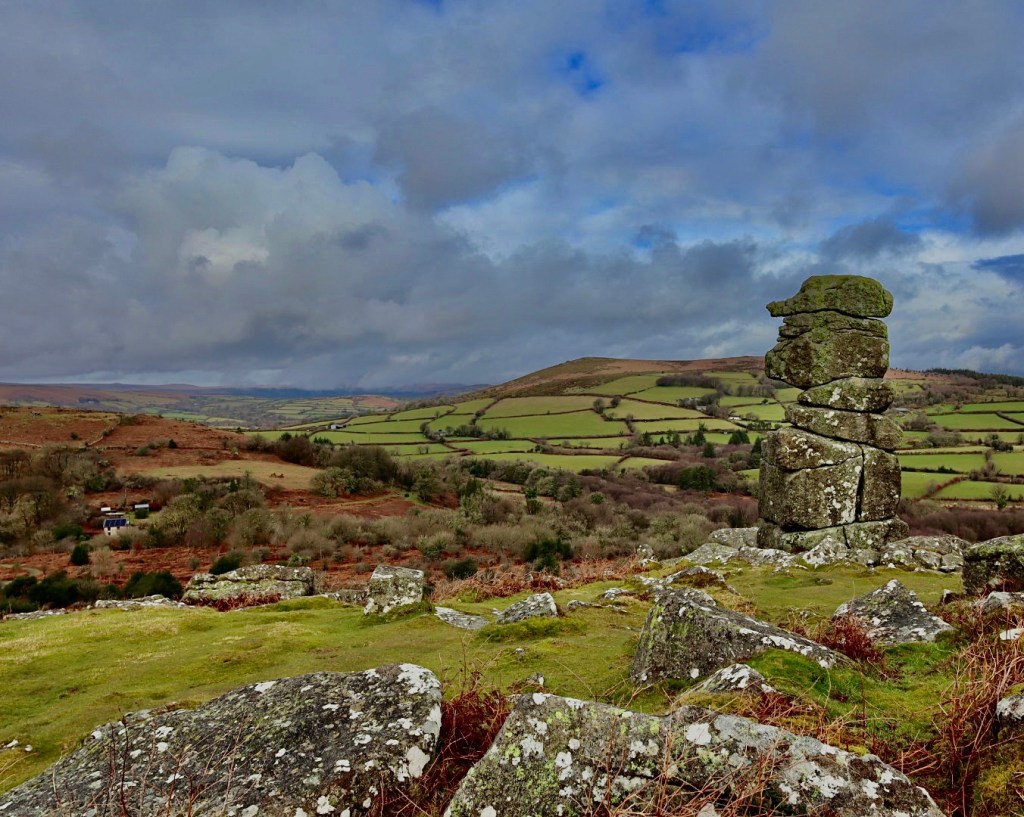
A short ascent is followed by a short decent which is the first point that Bowerman’s Nose comes to view. There are a number of animal trails and paths criss-crossing Hayne Down, upon which Bowerman’s Nose sits, but given the now suddenly clear visibility I cut a path over the previously ignored road and head directly to the curiously shaped stack of weathered granite that overlook the nearby village of Manaton. With a rock shaped like this, a legend is a necessity and the story that sits behind Bowerman’s nose is as intriguing and exciting as the rock itself. The Story of Bowerman, his pack of hounds and their battle with a local coven of witches has been retold in a separate post.

The route down the Eastern slope of Haynes Down is clearly marked by a man-made path and given the sodden underfoot conditions and steep descent, the presence of this path is a welcome sight. Following the path brings you through what OS maps marks as a non-coniferous wood. This wood is filled with twisting, ancient oaks and is bisected by a small stream. The path continues past a small farm, filled with curious cows, until it naturally merges into a road. Turn right at Hayne Cross and follow the twisting, turning road south (of note, I have walked this route on a number of occasions and only once have I seen a car on this road – and that was when I was driving that car having taken a wrong turn. To call this road quiet would be an understatement and for those of you who would rather not walk with the prospect of a car appearing, fear not, go through Southcott, where, midway through a right-hand bend, around 850m after the turn at Haynes Cross, you will see a small gate that allows you access into a field.
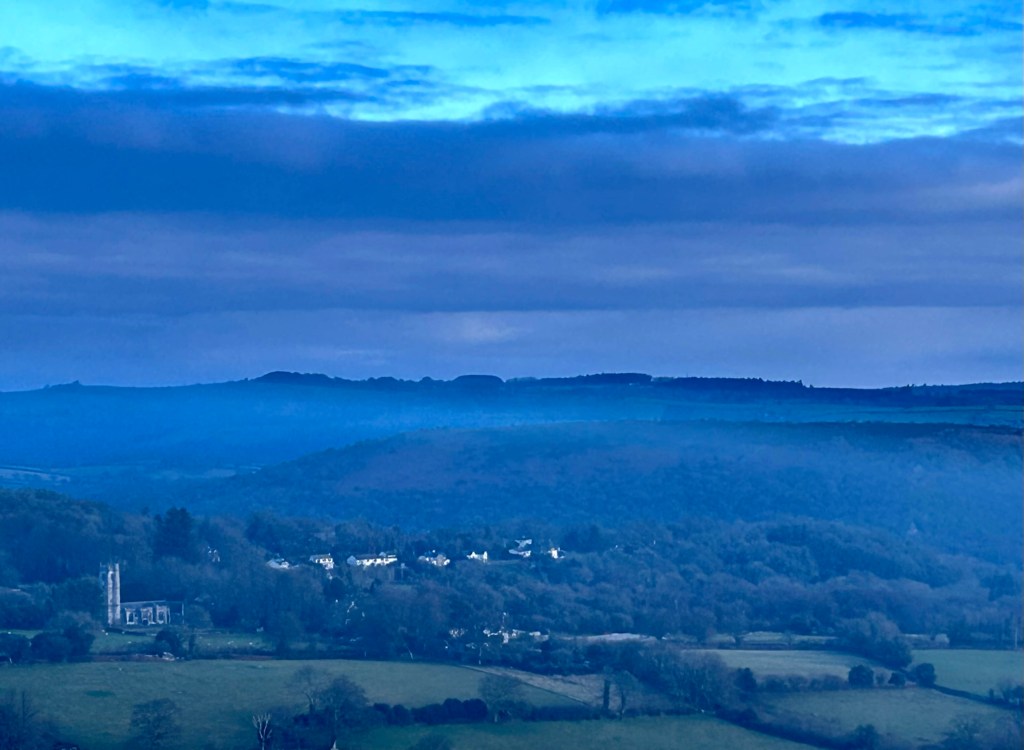
Entering this field, I am intently watched by a bull, guarding his field of heifers. Under the gaze of this ever-watchful animal (which I swear is growing in size with each nervous step I take), I make my way south through the entrance to a small wood. Crossing (what I’m going to call) a clapper bridge, continue to follow the path through the woods which eventually puts you onto another (incredibly quiet) road, after crossing a stile. Following this road along its length, you are brought uphill through a small village set amongst fields. It is here I see the elegant, streamlined shape of a Hobby sat upon the electrical wires, keeping an eye out for its prey. Annoyingly, it is quicker off the mark then I am and it flies away before I can get my camera out to take a photo. This unexpected site is a great demonstration of the variety of wildlife that calls Dartmoor home, providing a stark reminder of the preciousness of the environment in which we walk and play.
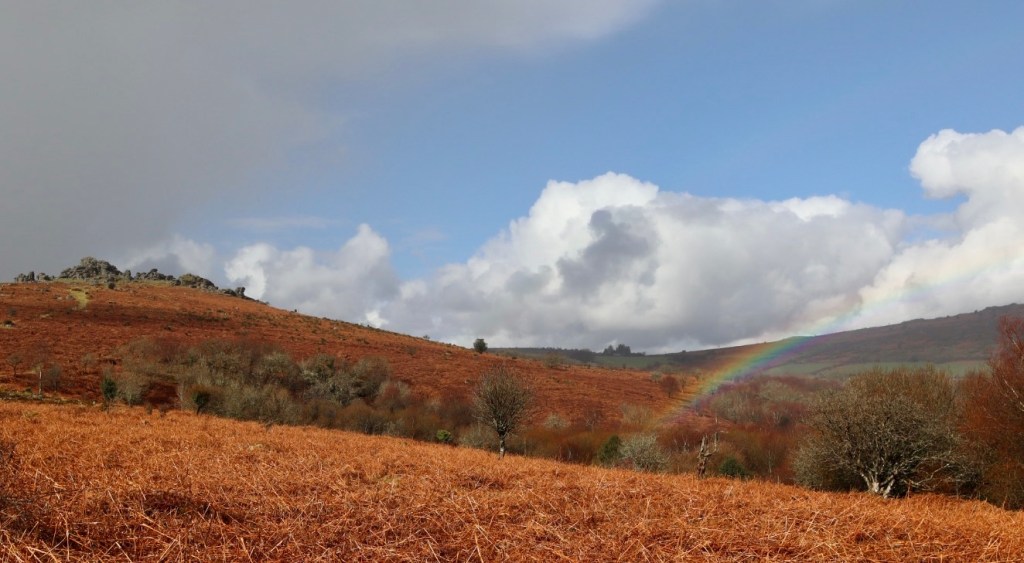
Continuing along the road (and honestly calling this a road feels disingenuous) you eventually come to a crossroads. I take the right-hand turn and continue uphill, when the heavens decide to open again. As annoying as this is, all is forgiven as the curving colours of a rainbow emerge to frame the emerging Hound Tor. The path on which I have appeared is at the base of Black hill, and following its south-westerly course brings you below Smallacombe Rocks and into a small wood. Continue along the clear route, passing by the mountain bikers and fell runners that frequent the area (for very clear reasons) take the bridge across Becka Brook and go through a gate, following the path uphill. Be warned, whilst only about 250m, this path is steep.
Now, I am one of those people that “run hot” and would always prefer to be walking in just a T-Shirt, even in wintery conditions. Therefore, ascending this hill in my waterproof jacket with a toddler on my back, is hard going. Not only do I find myself getting increasingly breathless, but I am sweating buckets by the top – thankfully (as I hit the busier part of the walk) the rain covers this up for me. As you reach the top of the hill, the view is amazing. Not only do you have Hound Tor overseeing the medieval settlement that sits at its base, but to your left is a rockpile, decorated in a network of plants and trees that give it an autumnal brown appearance, marked on the OS maps as Greator Rocks. The Rocks rise like a stately tower from the moors epitomising the raw beauty of Dartmoor. Sited at the transition between moorland and the woodland from which I have just emerged, the granite pile, along with its Hound Tor neighbour, offers shelter to the valley in which our medieval ancestors decided to settle.

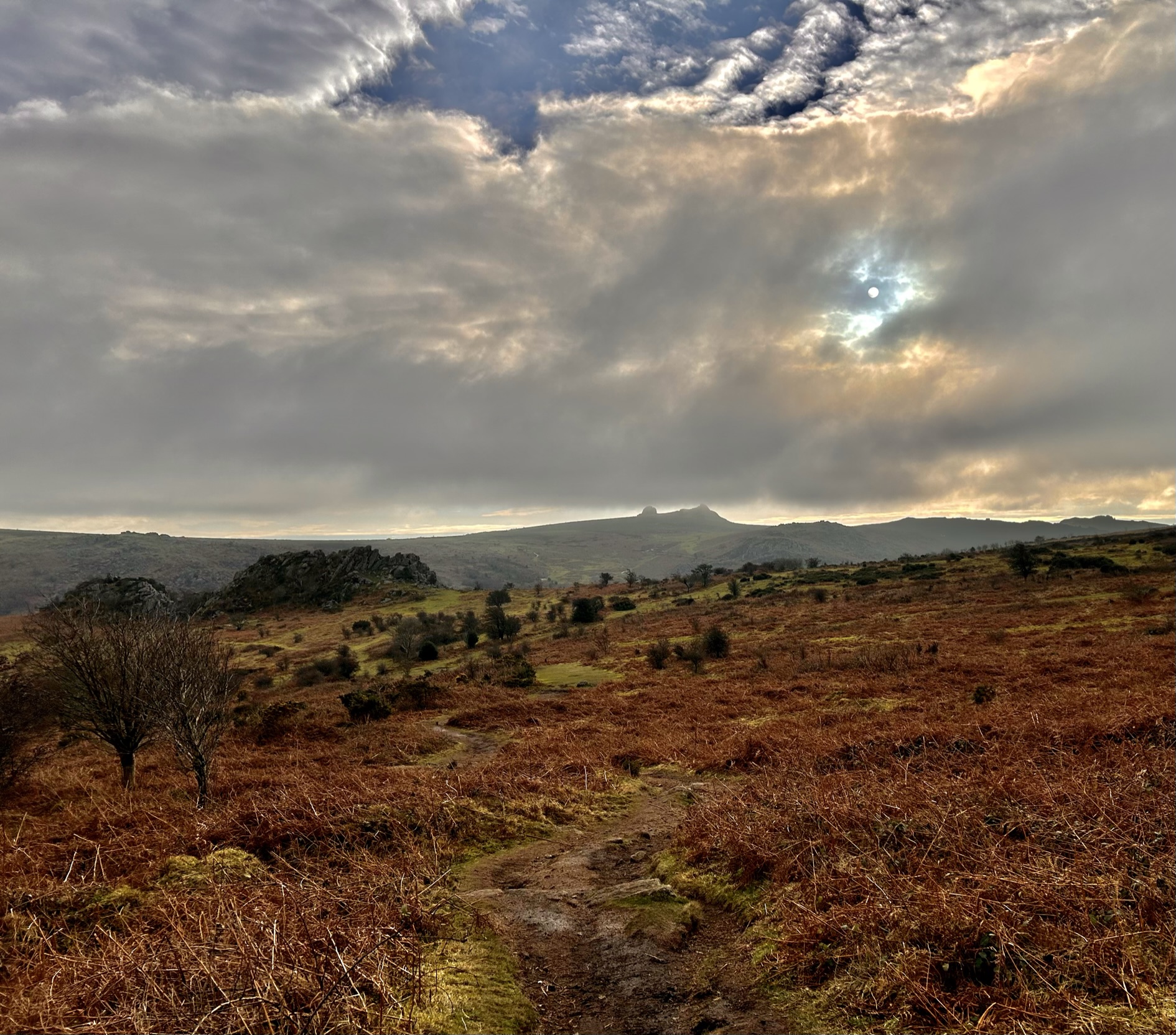
Following the route takes you through the medieval village which consists of cluster of 13th century longhouses. The evocative remnants of this small farming hamlet are clearly defined in the grasses of the landscape. As I walk amongst the remains of the deserted village, I find it easy to imagine what life must have been like for the settlers. Living amongst the wonderfully atmospheric stones, life would have been as harsh as the view was beautiful. As temperatures began to plummet and high rainfall caused crop failure (sounds familiar) outbreaks of disease continued to affect the animals and famine was common. The continued hardship was compounded in 1348 by the Black Death, and the combination is likely to have led to the abandonment of the settlement.

The settlement sits in the foothills of Hound Tor, and a clear path takes you up the south-westerly slope of Houndtor Down and onto the top of the hill that houses the Tor. The Tor is a popular with rock climbers as it is with walkers and it is easy to see why. Two massive granite stacks edge the top of the hill, offering visitors an avenue through which they can walk (Hound Tor is a stunning example of an “Avenue Tor”). The sheer size of the immense stacks does create a feeling of being crowded as you pass in between them, but this is more than worth it as the view opens up over to the west. From the top of the hill, there is an easy path down and back to the carpark. As I make way down, the heavens open in a biblical way throwing hail and rain down on all who walk beneath. I can’t quite be bothered to riffle through my backpack to get my coat out and instead take what nature has to offer – one final reminder from Dartmoor of our place in the world.
| Difficulty | Distance | Navigation Required? |
| Easy – with one steep hill that some may find difficult (but take it slow and this shouldn’t offer much trouble | 8kms | Yes but mostly paths |
| Grid Reference | Safety | Footwear |
| Start and Finish SX 739 792 | Care on crossing rivers Uneven terrain Road crossings General Dartmoor Considerations | Walking boots or shoes |

 Moorland Ramblings
Leave a comment